

You have lived a story worth telling. Maybe you survived something that would have broken most people. Maybe you built something from nothing, navigated a life nobody would believe, or simply accumulated six or seven decades of experience that your family — and the world — deserves to hear before it is gone.
The problem is not a shortage of material. The problem is that living a remarkable life and writing about it brilliantly are two entirely different skills — and most people who attempt to write their own memoir discover this somewhere around chapter three, when the enormity of the task and the difficulty of shaping lived experience into narrative form conspires to stop them completely.
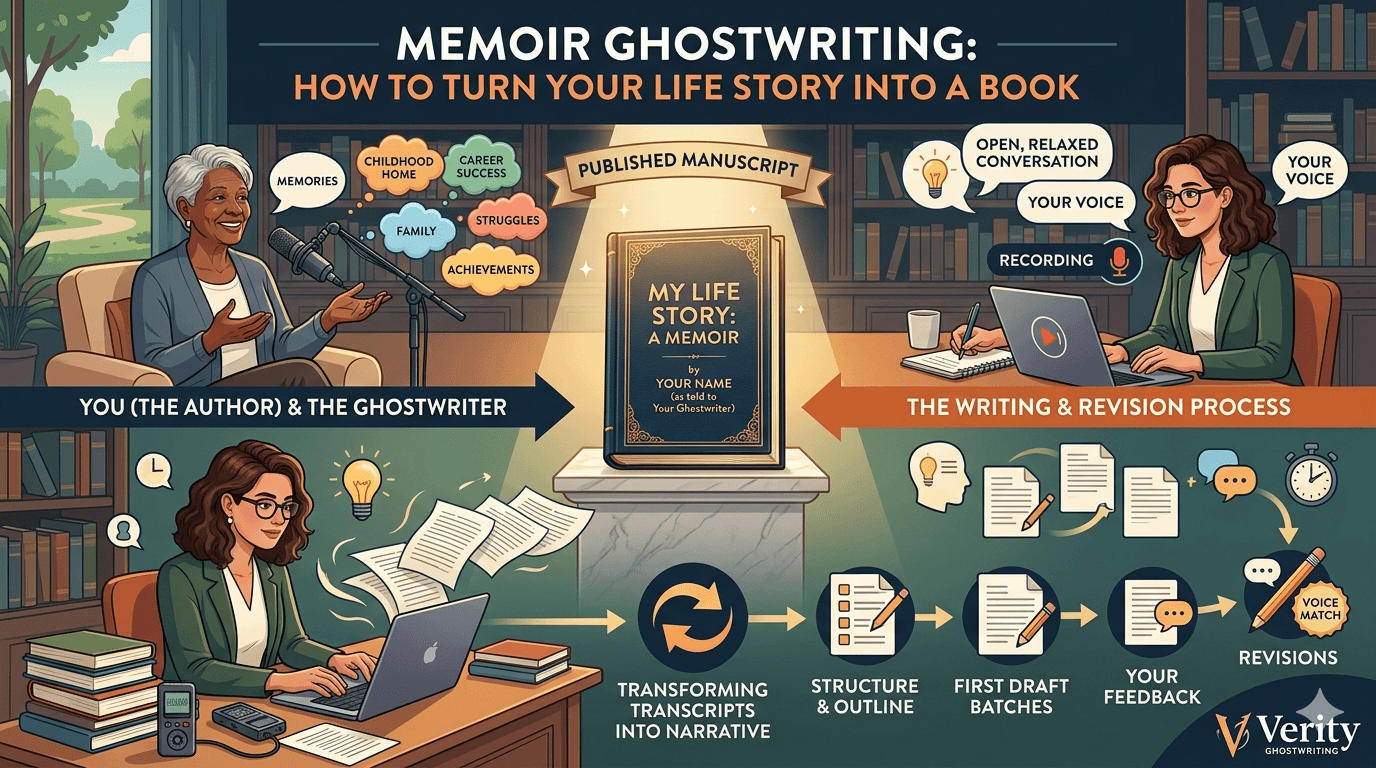
Memoir ghostwriting solves this. A professional memoir ghostwriter does not put words in your mouth — they listen, ask the questions that unlock the stories beneath the stories, and then craft your experiences into a book that reads as naturally and powerfully as if you had written every word yourself. Your voice. Your truth. Your name on the cover.
This guide covers everything you need to know about the memoir ghostwriting process: what makes a memoir work, how ghostwriters capture your voice, how to handle sensitive material, what the interview process looks like, and how to find the right person to help you tell your story. For a broader overview of how ghostwriting works across all book types, see the complete guide to book ghostwriting.
| Quick Definition
Memoir ghostwriting is the professional practice of hiring an experienced writer to turn your personal story into a publishable book — written in your voice, from your memories and experiences, under your name. The ghostwriter remains anonymous. You keep the byline, the rights, and the credit. |
Memoir vs Autobiography: What Is the Difference?
These two terms are often used interchangeably, but they describe meaningfully different things — and understanding the distinction will help you decide what kind of book you actually want to write.
| Memoir | Autobiography |
| Covers a specific period, theme, or aspect of your life | Covers your entire life chronologically from birth |
| Organised around a central narrative or emotional truth | Organised around the sequence of events in your life |
| Selective — chooses the moments that serve the story | Comprehensive — attempts to document the full life |
| Read like narrative non-fiction — story-driven | Read more like a formal life record |
| More commercially successful as a publishing category | More suited to public figures with historical significance |
| Examples: grief memoirs, recovery stories, career narratives | Examples: presidential memoirs, historical figures |
For most private individuals and professionals who want to share their story, memoir is the right format. It does not require you to document every decade of your life — it requires you to identify the experience, period, or theme that carries the most meaning, and to tell that story with honesty and craft.
A skilled memoir ghostwriter will help you make this choice if you are uncertain. The most powerful memoirs are almost always focused rather than comprehensive — they take one thread of a life and pull it until the reader understands something true about what it means to be human.
What Makes a Memoir Worth Reading?
The honest answer to this question is the one most people do not want to hear: your story being remarkable is not enough. Remarkable things happen to unremarkable writers every day, and remarkable writers can turn apparently ordinary lives into books that change people. What makes a memoir worth reading is not the events themselves — it is the craft with which those events are shaped into meaning.
The memoirs that stay with readers — the ones that get recommended, reviewed, and remembered — share a handful of qualities that have nothing to do with how dramatic the source material is.
A clear central question or truth
Every powerful memoir is built around something the author is trying to understand — about themselves, about the world, about what happened to them. The best memoirs do not simply recount events; they wrestle with what those events meant. The reader follows the author toward an answer, and the journey is the book.
Honest, specific detail
Vague, generalised writing kills memoirs. The specific sensory detail — the smell of the hospital corridor, the exact words your father said, the precise feeling of the moment everything changed — is what creates the illusion that the reader is inside the experience rather than hearing about it second-hand. A ghostwriter trained in memoir knows how to extract this specificity through careful interviewing.
A narrative arc
Even a memoir rooted in real events needs a dramatic structure. There should be a beginning that establishes the world as it was, a middle that shows it being disrupted or transformed, and an end that arrives somewhere meaningfully different from where it started. This is not fiction — you are not inventing events — but you are selecting and arranging them with intentionality.
Vulnerability without self-indulgence
The best memoirs are honest about the author’s flaws, mistakes, and confusion — not just their triumphs and wisdom. Readers do not connect with perfection. They connect with recognisable human struggle. At the same time, a memoir that exists purely to process the author’s pain, without offering the reader anything in return, is not a book — it is a journal. The distinction matters.
A voice the reader wants to spend time with
Voice is perhaps the single most important element in memoir. The author’s personality, humour, perspective, and way of seeing the world should be present on every page. This is also the single most important thing a memoir ghostwriter must get right — and the skill that separates a good ghostwriter from a great one.
How a Memoir Ghostwriter Captures Your Voice
This is the question almost everyone asks first, and it is the right one to ask. If the book does not sound like you — if it reads like someone else’s version of your story — it has failed at the most fundamental level, regardless of how well it is written.
Capturing voice is a craft that experienced memoir ghostwriters spend years developing. Here is how it actually works in practice.
Extended recorded interviews
The interview process is the heart of memoir ghostwriting. Over the course of multiple sessions — typically spread across the first two months of a project — the ghostwriter conducts in-depth recorded conversations with you about your life, your memories, your relationships, and your experiences. These are not structured questionnaires. They are guided conversations designed to draw out the stories, details, and emotional truths that the book will be built from.
A skilled memoir ghostwriter is also a skilled interviewer — someone who knows how to create the psychological safety that allows you to speak openly, and how to listen carefully enough to hear what is being said beneath what is being said. The follow-up question that unlocks a story is as important as any question on a prepared list.
Voice analysis from existing material
Any writing you have already produced — emails, letters, diaries, social media posts, speeches, articles — gives the ghostwriter a window into your natural voice. They will study how you construct sentences, what words you favour, how formal or informal your register is, what you find funny, and what you find important. This material is invaluable for calibrating the book’s voice before drafting begins.
Vocabulary and rhythm matching
Voice is not just personality — it is musicality. The length of your sentences, the words you naturally reach for, the pace at which you move between ideas, the way you use humour or pause for weight — all of these things are part of your voice, and all of them can be captured and replicated by a trained ghostwriter. Most clients are surprised, when they read the first drafted chapters, by how closely the prose sounds like them at their best.
Iterative feedback and calibration
No ghostwriter gets voice perfectly right on the first draft. The process of voice calibration happens across the early chapters, with the client providing feedback — ‘this sounds too formal,’ ‘I would never say it that way,’ ‘this section actually sounds exactly like me’ — that allows the ghostwriter to fine-tune before completing the manuscript. This is why delivering drafts in batches, rather than delivering the full manuscript at once, is standard professional practice.
Handling Sensitive Material in a Memoir
Memoir is the most personal form of writing that exists. That means it almost inevitably involves material that is complicated — difficult relationships, trauma, regret, addiction, abuse, loss, estrangement, betrayal. How you handle this material is one of the most important decisions in the entire project.
Honesty vs privacy: finding the balance
The most powerful memoirs are honest. But honesty does not mean including everything. You have the absolute right to decide what goes into your book and what stays private — and a good memoir ghostwriter will never pressure you to include material you are not comfortable with. The question to ask about every sensitive element is not ‘is this true?’ but ‘does this serve the book and the reader?’ If the answer is yes, include it. If it is simply painful without purpose, you may choose not to.
Writing about living people
This is where memoir becomes legally and emotionally complex. Writing about real, living, identifiable people — especially in ways that portray them negatively — carries risks that range from damaged relationships to legal action. A professional memoir ghostwriter will flag these risks as they arise and help you make informed decisions. In general, memoirs tell the author’s experience and perception honestly, rather than making factual claims about others’ motivations or actions that cannot be verified.
Legal considerations
Defamation, privacy invasion, and breach of confidence are the three legal areas most relevant to memoir. Defamation requires a false statement of fact that damages someone’s reputation. Writing what you honestly remember and believed to be true is generally a strong defence — but it is not absolute protection. For any memoir dealing with sensitive events involving identifiable living people, a legal read before publication is strongly advisable. Your ghostwriter can advise on which sections may warrant review.
Family and relationship dynamics
Many memoir clients find that the most difficult part of the process is not writing about their own experiences but anticipating how people in their lives will react to reading about themselves. There is no universal answer here — the right approach depends entirely on your relationships, your goals, and your circumstances. Some memoir authors choose to share relevant chapters with family members before publication. Others do not. What matters is that you make these decisions consciously and with a clear understanding of the potential consequences.
| A Note on Emotional Wellbeing
Revisiting difficult memories in depth, across multiple interview sessions, can be emotionally demanding — even for people who feel they have processed their experiences. A good memoir ghostwriter is sensitive to this. Sessions can be paused, redirected, or rescheduled if material becomes overwhelming. You are not obligated to go anywhere you are not ready to go. The book should be worth writing — and the process of writing it should not harm you. |
Memoir Structure: Chronological vs Thematic
One of the most significant structural decisions in any memoir is how to organise the material. There is no single right answer — the best structure depends on the nature of your story and what the book is trying to achieve. Here are the two primary approaches and when each works best.
| Chronological Structure | Thematic Structure |
| Events told in the order they happened | Events organised around themes, ideas, or emotional arcs |
| Natural and intuitive for most first-time memoir writers | Requires more editorial craft but can be more powerful |
| Works well for narratives with a clear linear arc | Works well when the meaning is more important than the sequence |
| Easier for the reader to follow | Creates richer, more layered reading experience |
| Risk: can feel like a list of events rather than a story | Risk: can feel disjointed if not handled with skill |
| Best for: coming-of-age stories, recovery narratives, career journeys | Best for: grief memoirs, identity explorations, complex family stories |
Many memoirs use a hybrid approach — broadly chronological but organised within that framework around thematic chapters rather than strict year-by-year progression. A skilled memoir ghostwriter will recommend the structure that best serves your specific story after the initial discovery and interview sessions have revealed what the material actually wants to be.
What the Memoir Interview Process Looks Like
If you have never worked with a ghostwriter before, the interview process is where the magic happens — and it is more collaborative and more illuminating than most clients expect going in.
How many sessions and how long
A typical memoir ghostwriting project involves between 15 and 30 hours of recorded interview sessions, spread across the first six to eight weeks of the project. Sessions are usually 60 to 90 minutes — long enough to go deep into a period or experience, short enough to maintain focus and emotional energy. The exact number depends on the complexity of the story and how much ground needs to be covered.
What the sessions cover
- Foundational sessions — your childhood, family, formative experiences, and the world you grew up in
- Core narrative sessions — the central events, relationships, and turning points the memoir will focus on
- Character sessions — the key people in your story, how you experienced them, what they meant to you
- Reflection sessions — what you understand now that you did not then, what you want the reader to take away
- Detail and colour sessions — sensory detail, specific scenes, dialogue, the texture of the world you are describing
You do not need to prepare
One of the things that surprises most memoir clients is how little preparation the sessions require. You do not need notes, an outline, or any particular order of thoughts. The ghostwriter’s job is to guide the conversation and ask the questions. Your job is simply to remember, to talk, and to trust the process. The best material almost always comes from unexpected directions — stories the client had not thought about in decades that turn out to be the emotional heart of the book.
What happens between sessions
Between interviews, the ghostwriter is transcribing, organising, and beginning to identify the structural shape of the material. They may send brief follow-up questions by email for small details that did not come up in session. By the time the interview phase is complete, the ghostwriter typically has a clear enough picture of the material to develop a detailed chapter outline for your review and approval.
Publishing Your Memoir: Self-Publishing vs Traditional Publishing
Once your manuscript is complete, you face the same publishing decision that every author does. For memoir writers, the calculus is slightly different from business authors — traditional publishing still carries meaningful weight in the memoir category, particularly for stories with broad commercial appeal.
| Factor | Traditional Publishing | Self-Publishing |
| Prestige and credibility | High — major imprint lends authority | Growing acceptance, especially for personal stories |
| Timeline to publication | 12 to 24 months post-acceptance | Weeks to months after final manuscript |
| Financial terms | Advance plus 10–15% royalty | Up to 70% royalty per copy sold |
| Gatekeeping | Agent required; highly competitive | No gatekeeping — publish on your terms |
| Editorial and design support | Provided by publisher | Your responsibility to commission |
| Distribution | Wide bookshop distribution | Primarily online; physical requires effort |
| Best for | Broad commercial appeal, public figures | Personal stories, family legacy, niche audiences |
For memoirs written primarily for family legacy, community, or a specific audience, self-publishing is almost always the right choice. It is faster, more personal, and gives you complete control over the finished product. For memoirs with genuine mainstream commercial potential — powerful, universally resonant stories — pursuing traditional publication through a literary agent is worth the effort, though you should be prepared for a longer and less certain road.
Memoir Ghostwriting Cost and Timeline
Memoir ghostwriting typically sits at the higher end of book ghostwriting costs, for reasons that are rooted in the nature of the work. Voice-matching at the level memoir requires, the extended interview process, the sensitivity and skill needed to handle personal material, and the narrative craft involved in shaping lived experience into compelling prose all demand a higher level of expertise than more straightforward non-fiction.
| Project Type | Typical Range |
| Short memoir (30,000 – 45,000 words) | $15,000 – $35,000 |
| Standard memoir (55,000 – 75,000 words) | $30,000 – $65,000 |
| Full-length memoir or biography (80,000+ words) | $50,000 – $100,000+ |
| Celebrity or high-profile memoir | $80,000 – $250,000+ |
| Typical timeline (standard memoir) | 5 to 8 months from first session to final manuscript |
These figures represent professional-quality ghostwriting from experienced memoir writers. Budget options exist at lower price points, but memoir more than any other book type suffers when the ghostwriter lacks the craft and sensitivity the work demands. For a fuller breakdown of what drives ghostwriting costs at every level, see the complete guide to ghostwriting pricing.
How to Find the Right Memoir Ghostwriter
Memoir is the most personal form of writing — which means the relationship between author and ghostwriter matters more here than in almost any other project. You are going to share things with this person that you may not have told many people in your life. Trust is not optional; it is foundational.
What to look for specifically in a memoir ghostwriter
- Memoir-specific experience. Not just general non-fiction experience. Memoir requires distinct skills — interviewing, voice-matching, narrative shaping, emotional sensitivity — that not every ghostwriter has developed. Ask specifically about their memoir projects and request samples.
- Active listening in the initial conversation. The discovery call tells you a great deal. Does this person ask thoughtful questions about you and your story? Or do they spend most of the call talking about themselves and their process? The best memoir ghostwriters are genuinely curious about people.
- Emotional intelligence and sensitivity. You need someone who can hold difficult conversations with care, who will not push you further than you want to go, and who understands the emotional weight of the material they are working with.
- A clear, structured process. Professional memoir ghostwriters have a defined process — for interviews, for outline development, for drafting and revision. Vagueness at this stage usually means vagueness throughout.
- References from memoir clients specifically. Testimonials from business book clients tell you relatively little about memoir capability. Ask for references from people whose memoirs or personal stories the ghostwriter has worked on.
For the full checklist of what to look for when hiring any type of ghostwriter, see the guide to 10 questions to ask before you hire a ghostwriter. And for guidance on whether to work with an agency or a solo freelancer, see ghostwriting agency vs freelancer.
FAQs
What is memoir ghostwriting?
Memoir ghostwriting is a professional service in which an experienced writer interviews you extensively about your life, experiences, and memories, then writes your memoir in your voice — under your name. The ghostwriter remains anonymous throughout. You own the book completely: the copyright, the byline, and all commercial rights. The result is a publishable memoir that sounds authentically like you, crafted to a professional standard.
Do I have to write anything myself?
No. Your contribution is your time, your memories, and your feedback — not your writing. The ghostwriter conducts all the interviews, does all the drafting, and handles the structural and editorial work from outline to final manuscript. You review chapters as they are delivered and provide feedback on voice, accuracy, and content. You do not need to write a single sentence.
How does the ghostwriter make the memoir sound like me?
Through an extended interview process — typically 15 to 30 hours of recorded conversation — the ghostwriter learns how you speak, what you emphasise, how you tell stories, what your sense of humour is like, and what matters most to you. They also study any existing writing you have produced — emails, letters, social posts — to calibrate your natural voice. Early chapter drafts are used as a voice-calibration tool, with your feedback used to fine-tune before the full manuscript is completed.
Can a ghostwriter handle sensitive or traumatic material respectfully?
Yes — and sensitivity to difficult material is a core skill of professional memoir ghostwriters. Sessions can be paused, redirected, or rescheduled if material becomes overwhelming. You are never obligated to include anything you are not comfortable with. A good memoir ghostwriter creates the psychological safety to explore difficult territory at your own pace, and brings the editorial judgement to help you decide what serves the book and what can stay private.
Does my memoir need to cover my entire life?
No — and the best memoirs almost never do. A memoir focused on a specific period, relationship, experience, or theme is almost always more powerful than a comprehensive life chronicle. You might write about your career, your recovery, your immigration story, a decade that changed everything, or a relationship that defined you. The scope is entirely your choice, and a good memoir ghostwriter will help you identify the focus that makes for the most compelling book.
What if I am worried about how family members will react?
This is one of the most common concerns memoir clients raise — and one of the most personal to navigate. There is no universal answer. Some authors choose to share relevant sections with family before publication; others do not. Your ghostwriter can help you think through the implications of specific content choices and flag sections that may warrant extra consideration. Ultimately, the decisions about what to include and how to handle family relationships in print are yours to make, with full awareness of the potential consequences.
Is memoir ghostwriting legal?
Yes, completely. Memoir ghostwriting is a legitimate professional service governed by a work-for-hire contract, which means you own the copyright to the manuscript from the moment it is created. The ghostwriter is contractually bound to confidentiality and has no claim on the work. For the full legal and ethical context, see the article on whether ghostwriting is legal.
How long does memoir ghostwriting take?
Most memoir ghostwriting projects take between five and eight months from the first discovery conversation to the final manuscript. Shorter, more tightly focused memoirs can be completed in four to five months. Longer, more complex narratives or biographies may run to ten months or more. For a full breakdown of timelines by project type, see the article on how long it takes to write a book with a ghostwriter.
What is the difference between a memoir and an autobiography?
An autobiography covers your entire life from birth to the present, organised chronologically. A memoir focuses on a specific period, experience, or theme — and is organised around narrative and emotional truth rather than chronological completeness. Memoir is by far the more commercially successful and reader-friendly format for most people. Autobiographies are typically reserved for public figures of significant historical importance.


