

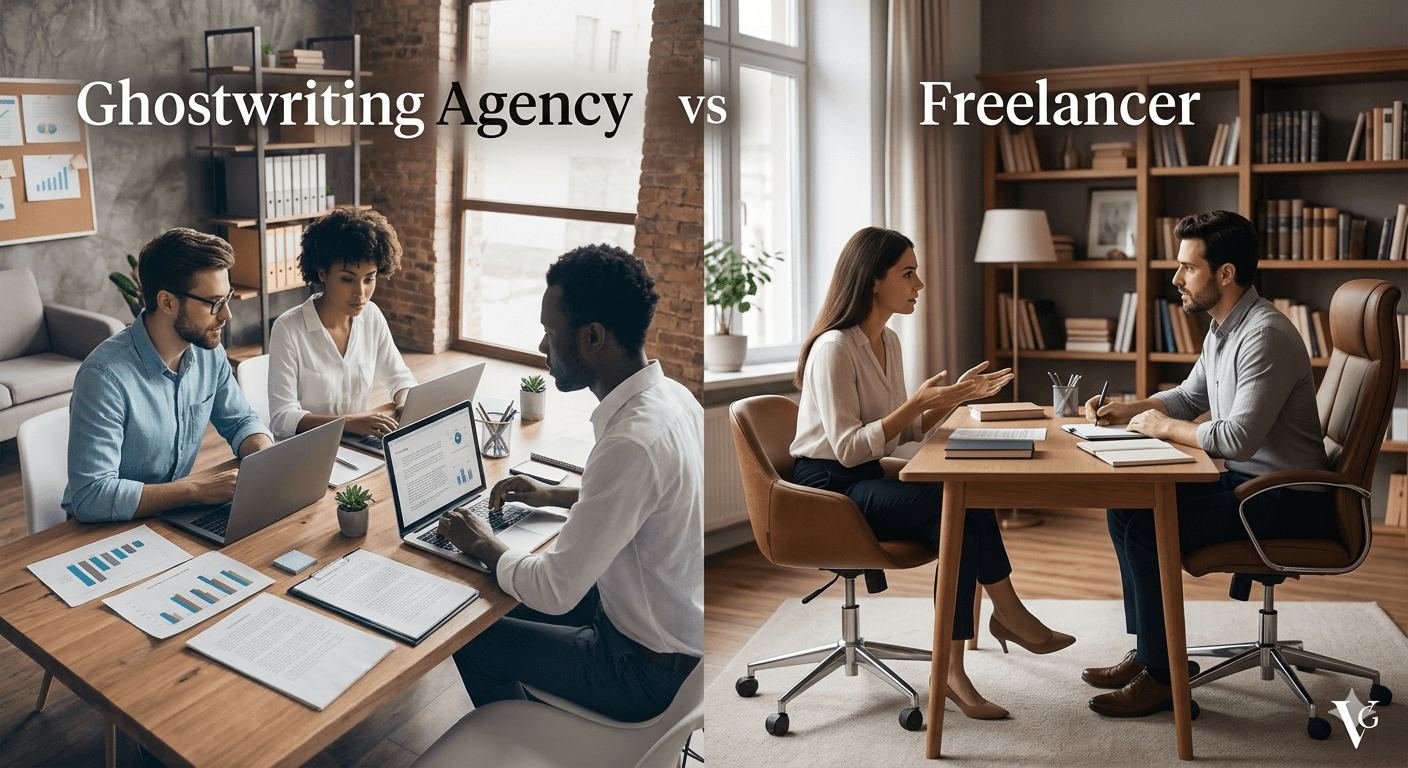
For a book or any high-stakes, long-form project, a ghostwriting agency offers accountability, quality control, and backup that a freelancer cannot. For shorter projects — a speech, a set of articles, an eBook, a skilled freelancer with relevant experience is often the better value. The right choice depends on your project’s complexity, your risk tolerance, and what happens if things go wrong.
Everything below explains the reasoning in detail.
When people start searching for a ghostwriter, most end up comparing two very different paths without quite realising it. One is a direct, personal relationship with a single writer. The other is a structured service with a team behind it.
Neither is automatically better. They are different products serving different needs — and most of the advice online either oversells agencies or romanticises freelancers without being honest about the real tradeoffs of each.
This article is different. We will tell you the genuine case for each, the genuine risks of each, and exactly which situations call for which approach.
What a Freelance Ghostwriter Actually Is
A freelance ghostwriter is an independent professional who works directly with you on your project. There is no intermediary, no team, no management layer — just you and one writer, working through your project together from start to finish.
At its best, this is a deeply rewarding creative relationship. A great freelance ghostwriter who is the right fit for your project becomes something rare: a person who understands your thinking, your voice, and your goals at a level that takes genuine time to develop. That understanding compounds as the project progresses.
The advantages of working directly with a freelancer are real:
Direct relationship. You work with one person throughout. They know your project completely. There is no briefing and rebriefing as tasks move between team members.
More flexibility. A freelancer can adapt their process to yours more easily than an agency with standardised workflows. If you want to work in a particular way, change direction mid-project, or communicate on your schedule, a freelancer typically accommodates that more naturally.
Potentially lower cost. Without an agency margin built into the price, freelancers at equivalent experience levels often cost less than working through an agency.
Niche expertise. The best freelance ghostwriters often have deep specialisation in a specific genre or industry — and that depth can be exactly what a particular project needs.
But the risks are equally real, and they are worth naming honestly.
Single point of failure. A freelancer who falls ill, takes on too many projects, goes through a personal crisis, or simply is not the right fit has no backup. You have no continuity, no safety net. Stories of freelance ghostwriters disappearing mid-project — or delivering work that bears no resemblance to what was promised — are not rare. They happen regularly enough that experienced clients account for them as a real risk.
Your responsibility entirely. Vetting, contracting, managing, and quality-checking the relationship falls entirely on you. If you do not know what good ghostwriting looks like, you may not recognise a problem until significant time and money have been invested.
No editorial oversight. What the ghostwriter delivers is what you get. There is no second reader, no editorial layer, no quality check built into the process.
What a Ghostwriting Agency Actually Is
A ghostwriting agency is a professional services firm that manages the ghostwriting process on your behalf — matching you with a writer, overseeing quality, managing the project timeline, and providing the kind of accountability that a solo freelancer simply cannot.
The advantages of working with an agency are structural rather than personal:
Vetting is done for you. A reputable agency has already evaluated their writers’ skills, reliability, and professional conduct. You benefit from that vetting without having to do it yourself. For most first-time clients, the amount of time and expertise required to vet ghostwriters properly — typically 25 to 50 hours for someone who knows what they are looking for — is itself a high cost.
Quality control is built in. At a professional agency, your manuscript goes through editorial oversight beyond the ghostwriter alone. Someone else reads it. Problems get caught. Standards are maintained.
Accountability is structural. If a ghostwriter assigned to your project becomes unavailable for any reason, a reputable agency has alternatives. Your project does not stall because one person got sick or overcommitted. This matters enormously for long projects where a great deal of planning depends on delivery.
A defined process protects you. Agencies have refined processes for onboarding, interviewing, outlining, drafting, and revising that are built from experience across many projects. For a first-time client, that structure is genuinely valuable — it means you are guided through each stage rather than having to figure it out yourself.
Escalation routes exist. If something goes wrong with an agency, there is someone to call. A complaint has a path. A problem has a resolution process. With a freelancer, a serious disagreement often has no escalation path beyond a legal dispute.
The genuine disadvantages of agencies are equally worth acknowledging:
The intermediary problem. Some agencies — particularly lower-quality ones — function essentially as brokers: they take a fee for connecting you with a writer and add no meaningful value in return. They are incentivised to fill your project quickly rather than ensure the match is genuinely right for you. This is the most important red flag to screen for. A reputable agency is invested in the outcome of your project. A broker-style agency is invested in making the introduction.
Higher cost. Agency overhead, management, and editorial layers are built into the price. For equivalent writing quality, you will typically pay more working through an agency than directly with a freelancer.
Fewer personal relationships. With a team structure, the intimacy of a direct one-on-one collaboration can be diluted. If the relationship between you and your assigned writer is the most important factor in producing great work — which, for memoir in particular, it often is — an agency environment may not nurture that as naturally as a direct freelance relationship.
The Real-World Decision Framework
Most of the advice on this topic reduces to “agencies are better for accountability, freelancers are better for cost” — which is true but not especially useful. Here is a more practical framework.
For a book — especially your first one — lean toward an agency. The project is long, the investment is significant, and the risks of a freelancer mismatch are high. You want quality control, backup, and a structured process that guides you through an experience you have never had before. The premium is worth it.
For a memoir specifically, prioritise the individual relationship above everything else. Memoir requires emotional trust, personal openness, and a specific human connection between you and your writer. If a particular freelancer gives you that feeling in a way no agency match does, that might outweigh the structural advantages of an agency arrangement. This is the one case where the personal relationship genuinely may matter more than process.
For shorter projects — speeches, eBooks, article sets — a skilled freelancer is usually the right call. The project is manageable, the timeline is short enough that single-point-of-failure risks are limited, and the lower cost makes sense for the scope. Focus your evaluation entirely on relevant samples and the quality of the first conversation.
For ongoing content — blog posts, LinkedIn, newsletters — a retainer arrangement with an individual ghostwriter often outperforms an agency. Consistency of voice matters enormously for ongoing content, and it develops better through a sustained direct relationship than through a team structure where the writer may change.
The Question Nobody Asks But Should
Before you decide between agency and freelancer, ask yourself a more fundamental question: how much do I actually know about what good ghostwriting looks like?
If you have hired ghostwriters before, worked in publishing, or have enough experience with the craft to evaluate quality and identify problems early, you are better equipped to manage a freelance relationship and can probably do so effectively.
If this is your first time, if you are not confident you would recognise a problem with the writing until it is too late, if you have a project where a failed outcome would be genuinely costly, the structure, vetting, and oversight of a reputable agency is not just a convenience. It is protection.
The most expensive ghostwriting project is not the most ambitious one. It is the one that fails halfway through.
How to Tell a Good Agency from a Bad One
Since the agency category includes genuinely excellent firms and broker-style operations that add no real value, here is how to tell the difference.
A good agency assigns a specific writer to your project and introduces you to them early. You should know who is writing your book before you sign anything. An agency that is vague about who specifically will be working on your project is probably a broker.
A good agency can show you the writer’s relevant work. Not just the agency’s portfolio — the specific writer’s samples in your genre. If the agency cannot show you what your actual writer has produced, you have no basis for evaluating the match.
A good agency has an editorial layer beyond the ghostwriter. Your manuscript should be read by someone other than the person who wrote it before it comes to you. Ask specifically what the editorial review process looks like.
A good agency is honest about limitations. The best agencies tell you when they are not the right fit for a particular project rather than trying to place everyone who walks through the door. If an agency is enthusiastic about your project regardless of what it is, that is a warning sign.
A good agency has a clear termination and dispute resolution process. Ask what happens if you are unhappy with the work or if the relationship breaks down. A legitimate agency has a clear, fair answer. A vague or defensive response tells you what you need to know.
Frequently Asked Questions
Are ghostwriting agencies more expensive than freelancers?
Generally yes — agency overhead, management, and editorial oversight are built into the price. For equivalent writing quality, you will typically pay 20% to 40% more working through an agency than directly with a freelancer of equivalent skill. Whether that premium is worth it depends on the complexity of your project and how much you value the additional accountability and structure.
Can a ghostwriting agency guarantee quality?
A reputable agency can guarantee a structured quality control process — editorial oversight, revision rounds, and accountability if the work does not meet agreed standards. No ethical agency can guarantee that the finished book will be a bestseller or that every reader will love it. Be suspicious of agencies that make those kinds of promises.
What if I am unhappy with the ghostwriter an agency assigns?
A reputable agency will have a clear process for reassigning your project to a different writer if the initial match is not working. Ask specifically about this before you sign. If an agency is evasive about what happens when a match fails, that is a significant red flag.
Is it safer to use an agency or a freelancer?
For a first-time client on a significant project, an agency is generally safer — not because freelancers are unreliable, but because the vetting, oversight, and backup structures that agencies provide reduce the most common risks. For experienced clients who know how to vet and manage freelancers effectively, the risk differential narrows considerably.
The Bottom Line
Agencies and freelancers are not competing versions of the same product. They are different arrangements suited to different situations — and the right choice is the one that fits your project’s specific complexity, timeline, and stakes.
If you are not sure which is right for your project, the most useful thing you can do is have a genuinely honest conversation with both a reputable agency and a strong freelancer candidate, and compare not just their prices but their processes, their questions, and the confidence they give you that your project will be in good hands.
At Verity Ghostwriting, we work as an agency — but we will tell you honestly in our free consultation whether a direct freelance arrangement might serve your project better. That kind of honesty is, we think, how a reputable agency should operate.


