

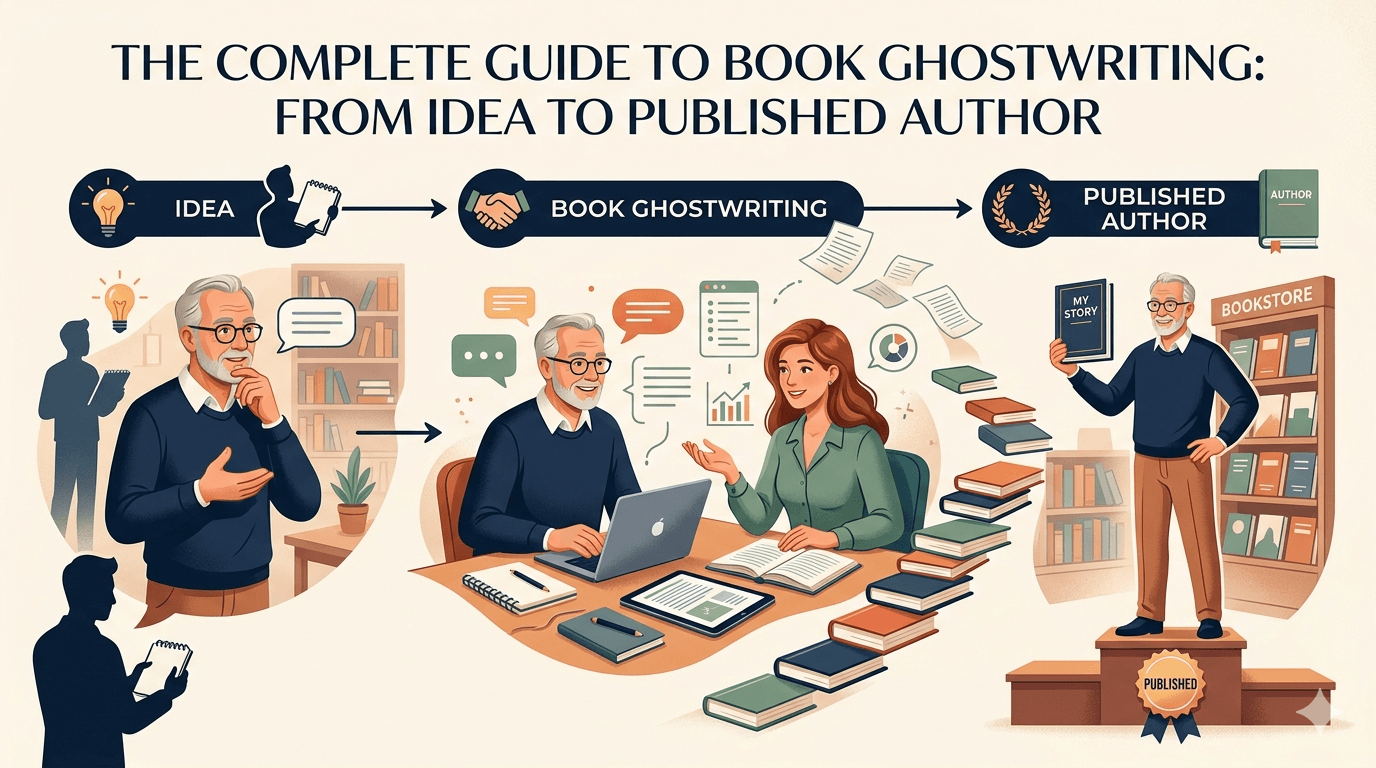
You have a book inside you. A story worth telling. An idea that could change the way people think about your industry. The problem is not the idea — it is the writing. And if writing is not your craft, trying to turn a powerful idea into a polished, publishable book can feel less like authorship and more like slow torture.
That is exactly what book ghostwriting is for.
Book ghostwriting is the professional practice of hiring an expert writer to write your book — in your voice, from your ideas — so that the finished manuscript is entirely yours. The ghostwriter stays anonymous. You keep the byline, the rights, and the credit. The result is a book that sounds like you at your absolute best.
This guide covers everything you need to know: what book ghostwriting actually involves, who it is right for, how the process works from first conversation to final manuscript, how much it costs, what to look for in a ghostwriter, and how to make your book a success once it is published. Whether you are an entrepreneur, a coach, a thought leader, or someone with a life story that deserves to be told, this is your complete starting point.
What Is Book Ghostwriting?
Book ghostwriting is a professional arrangement in which a skilled writer — known as a ghostwriter — writes a book on behalf of someone else. That person, called the client or named author, provides the ideas, experiences, expertise, and direction. The ghostwriter shapes all of that into a coherent, compelling, well-structured manuscript. The client publishes the book under their own name. The ghostwriter is not credited.
This is not a new concept. Ghostwriting has been a legitimate, widely accepted practice for centuries. Politicians, celebrities, business leaders, coaches, and entrepreneurs have all worked with ghostwriters to produce books that bear their names and reflect their voices — just written to a professional standard they could not have achieved alone.
The key distinction is this: the ideas and the story are always yours. The ghostwriter’s job is to find the best possible way to express them on the page.
| Quick Definition |
| Book ghostwriting is a professional writing service where an expert writer crafts your book from your ideas, in your voice, so you can publish it under your name — without writing a word yourself. |
Who Uses Book Ghostwriting?
The short answer: more people than you would expect, and more credible people than most readers realise. Book ghostwriting is used across every industry and every walk of life. Here are the most common client profiles.
Entrepreneurs and Business Owners
A book is the most powerful credibility tool a business owner can have. It establishes authority, opens doors to speaking engagements, generates leads, and differentiates you from every competitor who does not have one. Most entrepreneurs have rich expertise and compelling stories — but they are running businesses, not sitting at desks writing. A ghostwriter turns what is in their head into a business book that works.
Coaches, Consultants, and Thought Leaders
For people who sell their knowledge and expertise — coaches, consultants, therapists, trainers — a book is the ultimate lead generation tool. It demonstrates depth, builds trust before a first conversation, and positions them as the go-to authority in their niche. A well-written book does marketing work 24 hours a day. Ghostwriting makes that possible without pulling them away from their clients.
CEOs and Senior Executives
Executive ghostwriting is a thriving niche because senior leaders have something uniquely valuable to say — and absolutely no time to sit down and say it. A thought leadership book or personal-brand book can transform a CEO’s public profile, attract board seats, build a speaking career, and cement a legacy. The time required from the executive is minimal; the return can be extraordinary.
Professionals with a Life Story
Memoir ghostwriting is one of the most emotionally rich applications of the craft. People who have survived trauma, built something against the odds, travelled extraordinary journeys, or simply lived remarkable lives often carry stories that deserve to be told well. A skilled memoir ghostwriter captures those stories with sensitivity, structure, and narrative power — turning lived experience into a book others will not be able to put down.
First-Time Authors
Writing a book is genuinely difficult. It takes discipline, structure, and a professional understanding of how narrative and argument work at length. Many people who try to write their first book on their own abandon it somewhere in chapter three. A ghostwriter removes every barrier: the blank page, the structural confusion, the imposter syndrome, the isolation. They bring experience, process, and momentum to a project that might otherwise never be finished.
Types of Books That Are Ghostwritten
Book ghostwriting covers every genre and format. Below are the most commonly ghostwritten book types, along with what makes each one distinct.
| Book Type | Typical Client |
Key Considerations |
| Business / Non-Fiction | Entrepreneurs, consultants | ROI-driven, audience clarity, clear argument or framework |
| Memoir | Individuals with personal stories | Voice matching, emotional sensitivity, narrative structure |
| Leadership / Thought Leadership | CEOs, executives, public figures | Positioning, tone authority, audience-specific messaging |
| Self-Help / How-To | Coaches, therapists, experts | Actionable content, reader transformation, step-by-step structure |
| Biography | Public figures, families | Research-intensive, factual accuracy, narrative biography craft |
| Novel / Fiction | Creative clients with story ideas | Character, plot architecture, genre conventions |
| Children’s Books | Parents, educators, entrepreneurs | Age-appropriate language, character, illustration direction |
How the Book Ghostwriting Process Works
If you have never worked with a ghostwriter before, you might wonder how a writer who is not you can possibly produce a book that sounds like you. The answer lies in the process — and it is more collaborative, and more fascinating, than most people expect.
While every ghostwriter works slightly differently, professional book ghostwriting typically follows these core stages.
Stage 1: Discovery and Briefing
Before a single word is written, the ghostwriter needs to understand you: your voice, your story, your goals, your audience, and the book you want to produce. This usually happens through a series of in-depth conversations — sometimes called discovery calls or briefing sessions — where the ghostwriter asks carefully designed questions to extract the material they need.
This is also where you align on the book’s purpose. Is it a business development tool? A legacy memoir? A platform-builder for speaking? The purpose shapes every structural and editorial decision that follows.
Stage 2: Outline and Structure
Once the ghostwriter understands the material, they develop a detailed outline — the architectural blueprint for the book. This covers chapter structure, argument flow, key stories and anecdotes to include, and the overall narrative arc from opening to conclusion.
This is one of the most valuable stages. A professional ghostwriter brings structural expertise that most first-time authors do not have. The outline stage is where a collection of ideas becomes a coherent book. You review and approve the outline before any drafting begins.
Stage 3: Research and Interviews
Depending on the book type, the ghostwriter may conduct additional research — industry data, historical context, supporting evidence — and will typically conduct a series of recorded interviews with you. These interviews are the primary source material for memoir and leadership books: the ghostwriter listens carefully, asks follow-up questions, and captures the stories, language patterns, and personality that will define the book’s voice.
Stage 4: Drafting
The ghostwriter writes the first draft, chapter by chapter, guided by the approved outline and interview material. For a full-length non-fiction book (60,000–80,000 words), this stage typically takes three to six months, depending on complexity and the client’s availability for feedback.
Most professional ghostwriters deliver drafts in chapters or batches so that you can review progress, provide feedback, and ensure the voice is hitting correctly before the ghostwriter moves to the next section.
Stage 5: Revisions
No first draft is a final draft. The revision stage involves the client reading through completed draft material and providing feedback — not on the writing quality (that is the ghostwriter’s job) but on accuracy, voice, missing detail, and whether the content reflects their thinking correctly. Most professional arrangements include two to three rounds of revisions as standard.
Stage 6: Final Manuscript
Once revisions are complete and both parties are satisfied, the ghostwriter delivers the final manuscript. This is a clean, complete, publication-ready document. It is entirely yours. From this point, you move into the publishing phase — whether that is working with a literary agent, submitting to publishers, or proceeding with self-publishing.
| What Does ‘In Your Voice’ Actually Mean? |
| Voice is the combination of word choice, sentence rhythm, tone, personality, and perspective that makes your writing sound distinctly like you. A skilled ghostwriter learns your voice through interviews, any existing writing samples, and careful listening. They then replicate it consistently across the entire manuscript — so the book reads as naturally as if you had written every word yourself. |
How Long Does Book Ghostwriting Take?
One of the most common questions — and one of the most important things to plan around. Timeline varies significantly depending on book length, complexity, the ghostwriter’s process, and how quickly you can provide feedback and interview time. Here is a realistic framework.
| Book Type and Length | Typical Timeline |
| Short business book (30,000–40,000 words) | 3 to 4 months |
| Standard non-fiction (50,000–70,000 words) | 4 to 6 months |
| Full-length memoir or biography (70,000–90,000 words) | 6 to 9 months |
| Complex multi-part book or heavily researched work | 9 to 12 months |
| Rush project (shortened timeline on request) | Timeline halved, but premium rates apply |
The biggest factor in timeline is not the ghostwriter — it is you. Projects that stay on schedule are ones where the client is available for interviews, reviews drafts promptly, and provides clear feedback. Projects that stall almost always do so because the client becomes unreachable for weeks at a time.
If you want to learn more, the dedicated guide on how long it takes to write a book with a ghostwriter covers timelines in much greater detail — including a realistic month-by-month project map.
How Much Does Book Ghostwriting Cost?
Book ghostwriting is a significant investment — and it is worth understanding why before you see the numbers. You are paying for professional expertise, months of dedicated focus, the ability to extract and structure your ideas, voice-matching craft, and the experience to know what makes a book work. Cheap ghostwriting exists. It is also easy to spot — and it rarely produces a book you would be proud to put your name on.
Here is an honest overview of what book ghostwriting costs at different levels of the market.
| Market Tier | Typical Price Range | What You Get |
| Budget / Offshore | $3,000 – $8,000 | Basic drafting, minimal voice work, limited revisions |
| Mid-Market | $10,000 – $30,000 | Experienced writer, structured process, 2–3 revision rounds |
| Professional / Agency | $30,000 – $80,000 | Full-service, senior writer, strategy, publication support |
| Elite / Celebrity Ghostwriters | $80,000 – $250,000+ | Top-tier talent, major publishing house experience |
For most business books, memoirs, and thought leadership books produced by professional ghostwriting agencies, budgets between $20,000 and $60,000 are realistic for a high-quality result. The exact figure depends on word count, complexity, the ghostwriter’s experience, and whether the engagement includes any publishing consultation or post-manuscript support.
For a detailed breakdown of what drives pricing and what to expect at each level, see the complete guide to ghostwriting costs and pricing.
Business Book Ghostwriting: The ROI Perspective
For entrepreneurs, consultants, and coaches, the business case for a ghostwritten book is compelling — if you approach it strategically. The question is not just ‘how do I write a book?’ but ‘what do I want this book to do for my business?’
The most effective business books are engineered around a specific outcome. They are not written to impress — they are written to attract, to convert, to educate, and to close. A book that does this well becomes a 24/7 sales asset, a speaking pitch, a media calling card, and the best business card you will ever hand to a prospect.
What a Business Book Can Do for You
- Establish authority: A published book signals credibility that no website or LinkedIn bio can match.
- Generate leads: Readers who finish your book are pre-sold on your expertise. Many reach out ready to hire you.
- Command speaking fees: Event organisers book authors. A book is often the prerequisite for a speaking career.
- Differentiate from competitors: There are thousands of coaches and consultants. Very few have written a book.
- Create a premium positioning: Authors charge more. Clients perceive them differently. It is that simple.
The biggest mistake business authors make is writing a book about themselves rather than for their reader. The best business books are frameworks, stories, and insights that the reader finds immediately useful — and that naturally position the author as the person they want to hire to implement those ideas.
Memoir Ghostwriting: Telling a Life Story With Craft
Memoir is one of the most personally meaningful forms of ghostwriting — and one of the most technically demanding. A memoir is not a chronological record of your life. It is a narrative: shaped, structured, and crafted to take the reader on a journey that is emotionally true even when not strictly comprehensive.
Great memoir ghostwriting does several things at once. It captures your authentic voice — the way you actually speak and think. Selects the moments and memories that carry the most narrative weight. It handles sensitive material — difficult relationships, trauma, regret — with honesty and care. And it builds a reading experience that is compelling for someone who has never met you.
What to Expect from Memoir Ghostwriting
- Deep, extended interviews — often 20 or more hours of recorded conversation
- Careful voice analysis using any existing writing you can provide
- Collaborative decision-making about what to include, what to protect, and how to frame difficult material
- Structural choices between chronological narrative, thematic structure, or a combination
- Sensitivity around living people, legal considerations, and family privacy
The interview process is the heart of memoir ghostwriting. A skilled memoir ghostwriter is also a skilled interviewer — someone who knows how to create the psychological safety that allows you to speak openly, and how to ask the follow-up questions that unlock the stories beneath the stories.
How to Find and Choose the Right Book Ghostwriter
The single most important decision in a ghostwriting project is who you hire. A great ghostwriter can produce a book you are genuinely proud of. The wrong one can waste your money, your time, and leave you with a manuscript that does not represent you. Here is how to approach the search.
Where to Find Book Ghostwriters
Professional ghostwriting agencies — like Verity — are the most reliable route for most clients. Agencies vet their writers, manage the project, maintain quality control across the manuscript, and ensure you have recourse if something goes wrong. Freelance marketplaces exist, but the quality range is enormous and vetting responsibility falls entirely on you.
For context on the broader hiring landscape, see our detailed guide to hiring a ghostwriter, which covers the full process from sourcing candidates to signing contracts.
What to Look for in a Book Ghostwriter
| Green Flags | Red Flags |
| Published samples in a similar genre | No samples, or samples in an unrelated niche |
| Clear, structured onboarding process | Vague process with no defined stages |
| References from previous clients | Refuses to provide references |
| Transparent contract with clear deliverables | Verbal agreements only, or ambiguous terms |
| Active listening during initial calls | Does most of the talking; does not ask about you |
| Realistic timeline expectations | Promises a full book in 4 weeks |
Before you commit to anyone, ask yourself: does this person ask great questions? The best ghostwriters are genuinely curious about you, your story, and your ideas. If someone is already pitching solutions before they understand the problem, that is a warning sign.
It is also worth reviewing our guide to 10 questions to ask before you hire a ghostwriter — a practical checklist to use in your evaluation conversations.
Ghostwriting Contracts: What Should Be in Yours
Every professional book ghostwriting engagement should be governed by a formal written contract. This protects both parties — but it especially protects you as the client. Before you sign anything, make sure the following elements are clearly addressed.
- Ghost-authorship clause: Confirms that the ghostwriter assigns all rights to you and agrees never to claim authorship publicly.
- Confidentiality and NDA: Ensures that neither the existence of the arrangement nor any material discussed is disclosed.
- Work-for-hire ownership: Confirms that you own the manuscript and all derivative rights from the moment it is written.
- Deliverables and milestones: Specifies what is being produced, in what format, and by when.
- Revision rounds: Defines how many rounds of revisions are included and what constitutes an out-of-scope request.
- Payment schedule: Typically split into milestones — deposit, outline completion, draft completion, final delivery.
- Kill fee provisions: What happens if the project is cancelled partway through by either party.
For a more detailed breakdown of what to expect from a ghostwriting contract, see the dedicated guide to ghostwriting contracts.
From Manuscript to Published Book: Your Options
Once your manuscript is complete, you have two main routes to publication: traditional publishing and self-publishing. Each has real advantages and real trade-offs. Which is right for you depends on your goals, your timeline, and how much control you want over the final product.
| Traditional Publishing | Self-Publishing |
| Prestige and credibility of a major imprint | Full creative and commercial control |
| Editorial, design, and marketing support | Higher royalty per copy sold |
| Advance payment against future royalties | No gatekeeping — publish on your schedule |
| Lengthy process: 12–24 months post-acceptance | Can be live within weeks of final manuscript |
| Highly competitive to secure a deal | Distribution requires proactive effort |
| Publisher controls pricing and design | You fund all production costs upfront |
For most business books, thought leadership books, and personal brand books, self-publishing — done professionally — is increasingly the smarter commercial choice. You retain rights, publish faster, earn better royalties, and have full control over positioning. The stigma around self-publishing has largely disappeared, particularly in the business and non-fiction space.
For memoir authors or those targeting mainstream general audiences, traditional publishing still carries meaningful advantages — particularly if you can secure representation from a reputable literary agent.
Is Book Ghostwriting Legal and Ethical?
Yes — on both counts, unambiguously. Ghostwriting is a completely legal professional service governed by contract law. The arrangement is structured as a work-for-hire agreement, which means the ghostwriter legally assigns all rights to the client at the point of creation. There is nothing hidden or deceptive in the legal arrangement.
On the ethics question: the ideas, the experiences, the expertise, and the voice are all genuinely yours. The ghostwriter is a skilled craftsperson — like an architect who designs the house that the client will live in and put their name on. Nobody suggests that is unethical. Ghostwriting has been standard practice in publishing, politics, business, and entertainment for over a century, and it continues to be because it works.
The one genuine ethical exception is academic ghostwriting — submitting ghost-written work as your own in an academic assessment context, which violates institutional policies. Professional and commercial ghostwriting is an entirely different context.
For the full ethical and legal analysis, see the article on whether ghostwriting is legal.
Book Ghostwriting vs Co-Authoring: What Is the Difference?
These two arrangements are often confused, but they are structurally and legally distinct. Understanding the difference helps you choose the arrangement that actually fits your goals.
In ghostwriting, the writer is anonymous. You publish under your name alone. The ghostwriter has no public credit, receives a fee (not royalties), and has no claim on the work. The entire purpose of the arrangement is invisibility.
In co-authoring, both parties are credited on the cover. The writer typically receives a share of royalties in addition to or instead of a flat fee. The intellectual contribution is recognised publicly. Both parties have a stake in the book’s success.
For most clients — especially business authors and memoir writers — ghostwriting is the right structure. It is cleaner, it is more private, and it produces a book that reads as yours, not as a committee effort. For the full comparison, see ghostwriting vs co-authoring explained.
Famous Books That Were Ghostwritten
If you still feel uncertain about whether ghostwriting is a respectable path, consider that some of the most influential books ever published were written with significant ghostwriting involvement. The ideas and the platform were always the named author’s. The craft belonged to the ghostwriter.
- Many of the most widely read business and leadership books of the past 50 years were written with ghostwriting assistance
- Countless celebrity memoirs and autobiographies are produced with ghostwriters — often credited as ‘with [name]’ in the co-author sense, but frequently fully ghostwritten
- Political speechwriting — a form of ghostwriting — has been practised at the highest levels of government for as long as governments have communicated publicly
- Franchised non-fiction series across many categories are produced at scale with ghostwriting teams
The takeaway is not that ghostwriting is a secret — it is that great ideas deserve great execution, and the world has always found practical ways to make both happen together. For more on this history, see the article on famous ghostwritten books.
How to Make Your Book a Success After Publication
Publishing your book is the beginning, not the end. A book that sits unread on Amazon helps no one. Here is a framework for making your ghostwritten book do the work it was built for.
Before Launch
- Identify your target reader with precision — and write (or confirm) that the book speaks directly to them
- Build or leverage an existing email list, social platform, or professional network to prime your audience
- Develop your key messages and positioning statements before launch day
- Plan your launch window — coordinated activity in the first 30 days drives long-term visibility
At Launch
- Run a coordinated launch campaign: email, social, PR, and outreach to your network simultaneously
- Pursue reviews from credible voices in your industry before launch day
- Submit to relevant media — podcast appearances, guest articles, and press are the most effective book marketing tools
- Use your book as a direct business development tool — send copies to ideal clients and prospects
After Launch
- Extract the book’s content for ongoing marketing: chapters become articles, frameworks become LinkedIn posts, stories become talk material
- Use the book as a qualifying tool — prospects who read it arrive pre-convinced
- Update periodically if the subject matter warrants it — second editions signal continued relevance
A ghostwritten book that is properly positioned and actively used can generate leads, speaking opportunities, media appearances, and client relationships for years. The investment pays for itself many times over — but only if you treat the book as the business asset it is.
The Verity Ghostwriting Process for Books
At Verity, we specialise in producing books that represent our clients at their absolute best. That means getting the voice right, the structure right, and the message right — every time. Here is how we approach book projects.
- Discovery call: A detailed initial conversation where we understand your goals, your book, and whether we are the right fit for each other.
- Proposal and brief: We provide a clear, detailed written proposal including scope, timeline, deliverables, and pricing.
- Contract and onboarding: Full NDA and work-for-hire agreement signed before any work begins. Your confidentiality is absolute.
- Voice sessions: Extended recorded interviews with your dedicated ghostwriter to capture your ideas, stories, and voice.
- Structural outline: A complete chapter-by-chapter blueprint for your approval before drafting begins.
- Draft delivery: Chapters delivered in batches so you can review and guide the process in real time.
- Revision rounds: Multiple rounds of feedback incorporated until the manuscript is exactly right.
- Final manuscript: A complete, publication-ready manuscript delivered in your chosen format.
FAQs
Can a ghostwriter really capture my voice?
Yes — and this is the core skill of a professional book ghostwriter. Voice is captured through extended recorded interviews, careful analysis of any existing writing you have produced, and deliberate attention to how you phrase ideas, what you emphasise, and how you tell stories. Most clients are surprised by how closely the finished draft sounds like them — at their best.
Will anyone know my book was ghostwritten?
Only if you tell them. All professional ghostwriting arrangements include a full NDA. The ghostwriter is contractually prohibited from disclosing the arrangement. The book is published under your name, with your voice, and belongs entirely to you. There is no registry of ghostwritten books and no way for a reader to know.
What do I actually have to do during the process?
Your primary contribution is your time and your ideas. You will participate in a series of recorded interviews — typically 10 to 20 hours spread across the project — review chapter drafts and provide feedback, and be available for follow-up questions as they arise. You do not need to write a single word. The ghostwriter handles everything else.
How many interviews will I need to do?
For a standard non-fiction business book, expect 8 to 15 hours of interview time. For a memoir or biography, where the source material is predominantly your memories and experiences, it can be 20 to 30 hours or more. These are typically spread across several sessions over the first month or two of the project.
Who owns the copyright?
You do — entirely. The ghostwriting contract is structured as a work-for-hire agreement, which means copyright vests in you the moment the work is created. The ghostwriter retains no rights, earns no future royalties (unless separately negotiated), and cannot republish or reuse any part of the manuscript.
What happens if I am unhappy with the writing?
Professional ghostwriting contracts include defined revision rounds — typically two to three — specifically so that the manuscript can be refined based on your feedback. If the voice is off, or content is missing, or the structure is not working, you say so and the ghostwriter fixes it. At Verity, we do not consider a project complete until you are genuinely satisfied.
Can I use a ghostwriter if I have already written some of my book?
Absolutely. Many clients come with partial manuscripts — some with a few chapters, some with an outline, some with a rough 40,000 words that needs significant restructuring. A ghostwriter can take whatever you have, assess what is working, fill the gaps, and bring the whole thing to publication standard. Partial manuscripts are a very common starting point.
Is ghostwriting right for fiction?
Yes, though it is less common than non-fiction ghostwriting and requires a ghostwriter with specific fiction craft experience — character development, dialogue, plot architecture, genre conventions. If you have a story you want to tell but lack the fiction writing background to execute it, a fiction ghostwriter can be an excellent solution.
How do I know if my idea is strong enough for a book?
The question is less about the strength of the idea and more about whether there is a clear audience for it and whether you have enough to say. A discovery conversation with a professional ghostwriter will help you assess whether your material is book-length and whether it is positioned for the right reader. Most people have more to say than they realise.
What is the difference between a ghostwriting agency and a freelance ghostwriter?
An agency provides a managed service — project oversight, quality control, and accountability structures that a solo freelancer cannot offer. You work with a dedicated writer, but the agency ensures standards are maintained, timelines are met, and you have recourse if something goes wrong.
For a full comparison of your hiring options, see the article on ghostwriting agency vs freelancer.


