

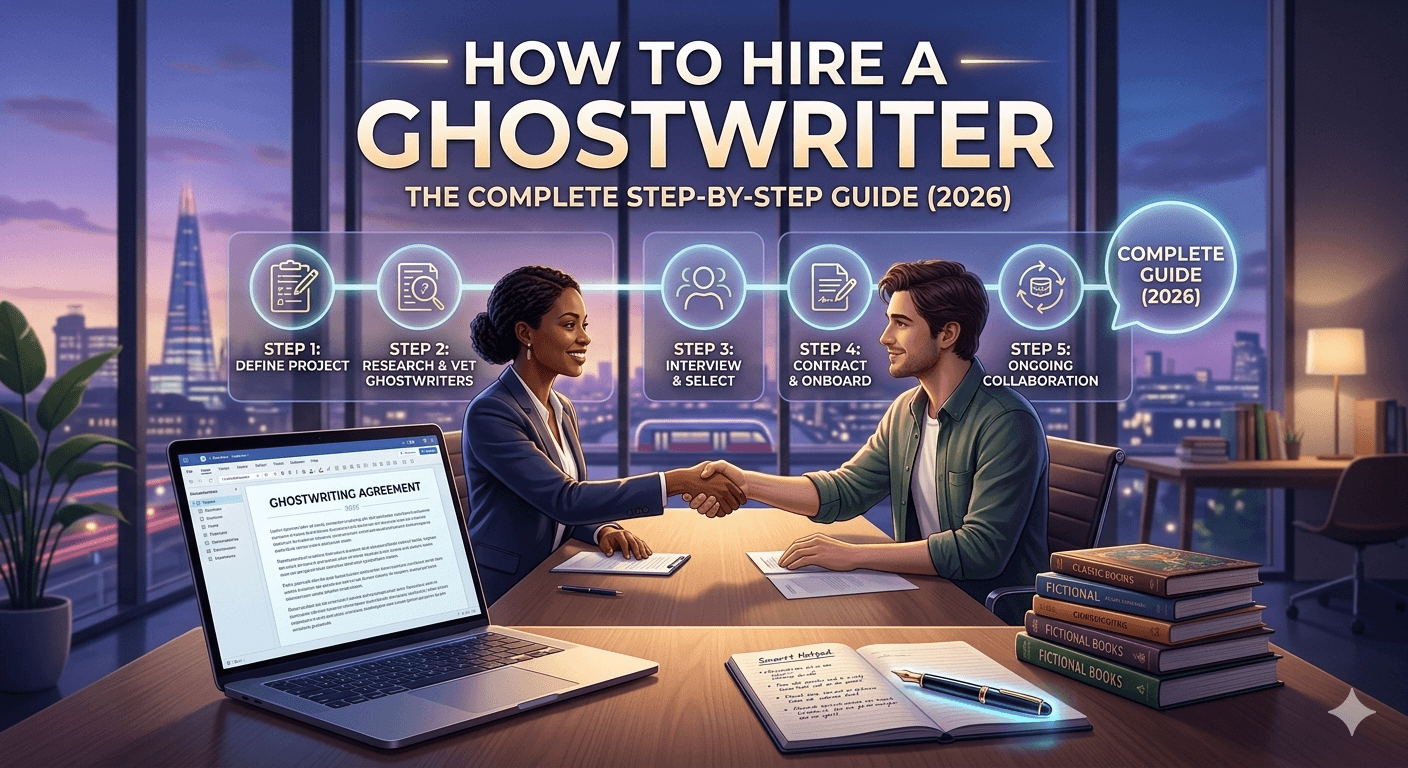
To hire a ghostwriter, clarify your project and budget first, then find candidates through referrals or specialist agencies, evaluate them on relevant samples and voice-matching process, sign a comprehensive contract that covers ownership and confidentiality, and expect to invest 8–15 hours of your own time in interviews before a word is written.
That is the essence. Everything below explains each step in detail — including how to hire a ghostwriter for a book specifically, what to pay, what red flags to avoid, and what the experience will actually feel like once you start.
Table of Contents
- Before You Start: Clarify What You Actually Need
- How to Hire a Ghostwriter for a Book
- How to Hire a Ghostwriter for a Memoir
- How to Hire a Ghostwriter for a Speech
- How to Hire a Ghostwriter for Blog Content
- Where to Find a Ghostwriter Online
- Agency vs Freelancer: What Is the Difference?
- How to Evaluate Candidates
- How to Read Writing Samples
- The First Conversation: What to Ask
- Understanding Ghostwriting Contracts
- Pricing: What You Should Expect to Pay
- Red Flags to Watch For
- What to Give Your Ghostwriter to Get Started
- Frequently Asked Questions
1. Before You Start: Clarify What You Actually Need
Most people who hire a ghostwriter for the first time make the same mistake: they start searching before they know what they are searching for. Before you contact anyone, get clear on four things.
What are you trying to create? A full-length business book, a memoir, a speech, a body of blog content, an eBook — these are completely different projects requiring different skills, different timelines, and different budgets. Know specifically what you need before evaluating who can deliver it.
What is your real goal? The surface-level goal is “I want a book.” The real goal is almost always something else — building authority, generating leads, leaving a legacy, landing speaking opportunities, or positioning for a career change. Understanding your real goal shapes everything: how the project should be structured, what tone it should take, and what success looks like.
What is your genuine budget? Not the budget you wish you had — the budget you actually have. For a full-length book, professional ghostwriting starts at around $20,000. For shorter projects, the ranges are more accessible. Knowing your real number lets you have honest conversations.
What is your timeline? A realistic timeline for a full-length book is four to nine months. If you have a specific external deadline — a conference, a product launch, a milestone — communicate it upfront to every candidate you speak with.
2. How to Hire a Ghostwriter for a Book
Hiring a ghostwriter for a book is the most significant and most involved ghostwriting engagement. Here is what the process specifically looks like for book projects.
Step 1 — Define your book clearly. Before speaking to any ghostwriter, know your book’s core premise, your target reader, and the specific outcome you want the book to produce. A vague brief produces a vague book. A ghostwriter can help you sharpen these things — but having a clear starting point saves weeks.
Step 2 — Look for book-specific experience. A ghostwriter who produces excellent blog content is not necessarily equipped for a 60,000-word book. Look specifically for ghostwriters who have book-length projects in their history — ideally in your genre. Ask directly how many books they have ghostwritten and what happened to those books after delivery.
Step 3 — Evaluate their structural thinking. Book ghostwriting is as much about architecture as it is about prose. In your first conversation, ask them how they would approach structuring a book like yours. A strong response shows structural instincts — how to open, how to build an argument or a narrative, how to maintain momentum across chapters. A weak response reveals someone who thinks only at the sentence level.
Step 4 — Request a sample chapter or outline proposal. Many professional book ghostwriters offer a paid sample chapter early in the process — typically 1,500 to 3,000 words — so you can evaluate voice matching and structural approach before committing to the full project. This is worth paying for. It is far less costly than discovering a mismatch after months of work.
Step 5 — Confirm the full process. For a book, the process typically runs: discovery call → proposal and contract → onboarding interviews (8–15 hours) → outline approval → chapter-by-chapter drafting → revision rounds → final delivery. Make sure your ghostwriter can articulate every stage.
→ Read more: How the Ghostwriting Process Works: From First Call to Final Draft
3. How to Hire a Ghostwriter for a Memoir
Memoir ghostwriting has specific requirements that set it apart from other book projects. Here is what to look for.
Emotional intelligence matters as much as writing skill. Memoir involves sharing private experiences — sometimes painful, sometimes private, sometimes complex. Your ghostwriter will hear stories you have never told publicly and will need to handle that material with sensitivity, discretion, and genuine care. Look for someone whose listening skills and emotional presence make you feel safe being open.
Voice matching is especially critical. In a memoir more than any other genre, the writing must sound unmistakably like you. Readers are buying your story told in your voice — not a polished, generic narrative. Ask specifically how the ghostwriter approaches voice capture for memoir projects, and ask to read a memoir sample they have written.
Research and verification matter. Memoir involves real events, real people, and real timelines. A professional memoir ghostwriter helps you organise your memories accurately, identify what can be verified, and flag anything that might create legal exposure around living people.
Privacy and confidentiality are paramount. Your memoir involves your life. Ensure the NDA is comprehensive and covers every aspect of the collaboration — not just the final manuscript but the stories shared during interviews.
4. How to Hire a Ghostwriter for a Speech
Speech ghostwriting is a distinct specialisation. Writing words designed to be delivered in a room — words that must sound completely natural when spoken aloud, land emotionally in real time, and be memorable without notes — requires different skills from prose writing.
Look for speechwriting-specific experience. A ghostwriter who produces beautiful prose does not automatically produce a great speech. Ask specifically about their speechwriting background. Have they written for live audiences? For what occasions? How do they approach the difference between written and spoken language?
The brief matters enormously. For a speech, your ghostwriter needs to understand the occasion, the audience, the venue, the desired emotional arc, and exactly how long the delivered speech should run. The more specific your brief, the stronger the first draft will be.
Allow time for rehearsal feedback. A speech ghostwriter should ideally revise based on how the speech sounds when you read it aloud — not just how it reads on the page. Build in time for at least one round of revision after you have rehearsed it.
Timeline is compressed. Speech ghostwriting is typically faster than book work — a keynote speech of 20 to 30 minutes can usually be produced within two to four weeks. Rush delivery for high-stakes occasions is available but costs more.
5. How to Hire a Ghostwriter for Blog Content
Hiring a ghostwriter for ongoing blog content, LinkedIn articles, newsletters, and website copy is a different kind of engagement from book ghostwriting — and requires a different evaluation approach.
Consistency matters more than any single piece. A content ghostwriter needs to maintain your voice reliably across dozens of pieces over months. In your evaluation, read multiple samples from a single client rather than individual showcase pieces. Does the voice stay consistent? Does the quality hold up under production pressure?
Set up a trial assignment. For ongoing content work, a paid trial assignment of one or two articles is the standard way to evaluate fit before committing to a retainer. This costs a modest amount but saves significant time and frustration.
Establish a brief template early. Content ghostwriting works best when you have a consistent way to brief each piece — your angle, your key point, any examples you want included, and the audience you are speaking to. A good content ghostwriter will help you develop this template during onboarding.
Retainer arrangements work better than per-piece commissioning. If you need consistent output, a monthly retainer with a fixed number of pieces is more efficient than one-off commissions. It gives the ghostwriter stability, gives you reliable capacity, and builds a deeper understanding of your voice over time.
6. Where to Find a Ghostwriter Online
There are several routes to finding a professional ghostwriter, each with different tradeoffs.
Specialist ghostwriting agencies like Verity Ghostwriting are the most reliable route for complex or high-value projects. They vet their writers, manage quality control, have established processes, and offer accountability that individual freelancers cannot. They charge more — and for book projects, the premium is usually worth it.
Referrals from trusted sources are consistently the most reliable way to find individual ghostwriters. Ask colleagues, peers, or mentors who have published books whether they worked with a ghostwriter they would recommend. A personal referral removes significant uncertainty.
Publishing-focused platforms like Reedsy connect clients with vetted freelance ghostwriters who have publishing credentials. The platform handles contract logistics and escrow payments, making it safer than open marketplaces.
LinkedIn and professional networks can surface strong candidates, particularly for business content and thought leadership writing. Search specifically for ghostwriters in your niche rather than generalists.
Open freelance marketplaces like Upwork and Fiverr have large numbers of ghostwriters at very wide price ranges. The quality variance is enormous, vetting is entirely your responsibility, and the cheapest options almost always produce the weakest results. For low-stakes, high-volume content these platforms can work. For a book, memoir, or anything that carries your professional reputation, the risk is too high.
7. Agency vs Freelancer: What Is the Difference?
A freelance ghostwriter offers flexibility and often a lower cost. You work one-on-one with a single writer throughout the entire project. The quality of that relationship is everything — when it works, it is excellent. When it does not work, there is no structural support to fall back on.
A ghostwriting agency provides structure, oversight, and accountability. Agencies vet their writers, manage quality control, offer replacements if a match is not working, and have established processes for the most common challenges. They typically charge more — and for complex, high-value projects that premium is usually the right investment.
The practical rule of thumb: for a book or long-form project where the stakes are high and the investment is significant, an agency’s accountability and process management offer genuine protection. For shorter projects — a speech, a set of articles, an eBook — a trusted freelancer with relevant experience is often entirely appropriate.
8. How to Evaluate Candidates
Most clients focus almost entirely on writing samples and price. Both matter — but neither is the most important factor.
The most important factor is fit. You are going to work closely with this person for months. You are going to share ideas, stories, and in many cases private or sensitive material. If the chemistry is wrong in the first conversation, it will not improve during a long project.
Look for relevant genre experience. A ghostwriter who excels at business books is not automatically right for a memoir. Experience in your specific format matters.
Evaluate their questions, not just their answers. The best ghostwriters ask as many questions as they answer. Curiosity, specificity, and genuine interest in your project signal someone who will invest properly in understanding you before writing.
Check their process explicitly. A professional ghostwriter has a clear, structured process they can explain specifically. Vagueness about how they work is a warning sign.
→ Read the full guide: 10 Questions to Ask Before You Hire a Ghostwriter
9. How to Read Writing Samples
Most clients read samples the wrong way — looking for beautiful sentences and then hiring based on that alone. Here is what you should actually be evaluating.
Does it sound like a specific person? Good ghostwriting sounds like its named author — not generic professional writing. You should feel a specific personality behind the words.
Does the structure work? For long-form samples, pay attention to how the argument develops and whether the architecture holds together. A ghostwriter who cannot structure a 2,000-word article will struggle with a 60,000-word book.
Does it hold your attention? If you find yourself skimming, the writing is not doing its job regardless of how technically correct it is.
Is the voice consistent throughout? Read the full sample, not just the opening. Maintaining voice and quality across a long piece is harder than producing a strong first few paragraphs.
10. The First Conversation: What to Ask
Come prepared with specific questions — not a generic checklist but questions genuinely relevant to your project. How have they handled similar projects? What does their revision process look like? How do they approach voice matching? What have they found most challenging about projects like yours?
Then listen to how they answer — and particularly to the questions they ask you. Experienced ghostwriters are intensely curious about their clients. A ghostwriter who talks mostly about themselves and asks little about you is not genuinely invested in your outcome.
Pay attention to honesty over enthusiasm. The best ghostwriters tell you when something is more complicated than you think or when your timeline is unrealistic. Enthusiasm designed to close the deal is less valuable than professional candour.
11. Understanding Ghostwriting Contracts
Never begin a ghostwriting project without a comprehensive written contract. A professional contract must include:
Scope of work — exactly what will be delivered, including word count, format, revision rounds, and what editing service is included.
Timeline and milestones — specific dates for each deliverable, including the outline, drafts, and final delivery.
Payment structure — instalments tied to project milestones, not entirely upfront and not entirely on delivery.
Revision terms — how many rounds are included and what constitutes a scope change versus a standard revision.
Copyright and ownership — an explicit work-for-hire clause transferring all intellectual property completely to you.
Confidentiality and NDA — comprehensive non-disclosure covering the ghostwriter’s obligation to maintain confidentiality about everything related to the project.
Termination clause — what happens if the project ends before completion, including how much fee is retained and what rights you have to work on the completed.
12. Pricing: What You Should Expect to Pay
Full-length nonfiction books: $20,000 to $80,000+. Most professional book ghostwriting in the USA falls between $30,000 and $60,000.
eBooks and shorter books: $2,000 to $10,000, depending on length and research.
Blog and article ghostwriting: $200 to $1,500 per article, or $1,500 to $6,000 per month on retainer.
Speech ghostwriting: $1,500 to $8,000 for a keynote or major address.
LinkedIn ghostwriting packages: $1,500 to $5,000 per month.
Whitepapers and business writing: $3,000 to $15,000, depending on scope.
One principle worth internalising: the cost of bad ghostwriting is almost always higher than the cost of good ghostwriting. A cheap manuscript that does not sound like you, that requires complete rewriting, or that you never feel confident publishing, wastes both money and time.
→ Read the full breakdown: How Much Does a Ghostwriter Cost in 2026?
13. Red Flags to Watch For
Unusually low pricing. A full-length book for $2,000 to $3,000 is a guarantee of generic work that will not represent you well.
Vague answers about the process. A professional ghostwriter can explain their process specifically. Vagueness indicates lack of experience.
Resistance to a contract. No professional should resist working within a comprehensive written contract.
Promises of extremely fast delivery. A 60,000-word book in four weeks is not possible at professional quality. This signals AI-generated content without disclosure or severely compromised quality.
No relevant samples. A ghostwriter with no track record to show has no track record.
Excessive enthusiasm without question. A ghostwriter focused entirely on selling you their services who asks little about you is not invested in your outcome.
14. What to Give Your Ghostwriter to Get Started
This is one of the most practical questions clients have — and one that is rarely answered clearly anywhere.
Here is what a professional ghostwriter needs from you to produce their best work:
Your existing writing. Emails, presentations, articles, social media posts, previous drafts — anything you have written. This gives the ghostwriter their first detailed picture of your voice before interviews begin.
Your vision for the project. Not a polished brief — just your honest sense of what you want the finished work to be, who it is for, and what you want readers to do or feel after reading it.
Your key stories and examples. The specific moments, case studies, or experiences that illustrate your ideas most powerfully. These are the raw material that makes the work feel genuinely yours rather than generic.
Reference titles. Books, articles, or speeches whose tone, style, or structure feels close to what you are aiming for. This is enormously helpful for voice and register calibration.
Your honest availability. How many hours per week can you commit to interview sessions and feedback? Knowing this upfront helps set a realistic timeline and prevents the project stalling at critical stages.
You do not need to arrive with a finished outline, a structured manuscript, or fully formed chapters. You need your ideas, your voice, and your willingness to show up for the conversations that make great ghostwriting possible.
Frequently Asked Questions
Is it worth hiring a ghostwriter?
Yes — if you have valuable ideas, expertise, or a story to share and lack the time or skill to write it at the level it deserves. A well-executed ghostwritten book, speech, or body of content can generate authority, clients, speaking opportunities, and lasting professional value that far exceeds the upfront investment. The question is not whether ghostwriting is worth it in general — it is whether your specific project and goals justify the investment.
How do I find a trustworthy ghostwriter?
The most reliable route is a referral from someone who has used a ghostwriter and was genuinely happy with the result. A specialist ghostwriting agency that vets its writers is the next most reliable option. Whatever route you take, a comprehensive contract with clear ownership, confidentiality, and termination terms is what actually protects you — not the ghostwriter’s reputation alone.
What information do I need to give a ghostwriter?
Your existing writing, your vision for the project, your key stories and examples, reference titles whose style you admire, and your honest availability for interview sessions. You do not need a finished manuscript or a polished brief — you need your ideas and your willingness to be interviewed thoroughly.
How do I know if a ghostwriter is good?
Read samples that are genuinely relevant to your project type. Ask them how they capture voice specifically. Listen to the quality of their questions about your project. Request a paid sample chapter before committing to a full book project. And trust your instincts about whether this person genuinely understands and is invested in what you are trying to achieve.
Can I hire a ghostwriter to write my life story?
Yes — memoir ghostwriting is one of the most common and well-established forms of ghostwriting. A skilled memoir ghostwriter interviews you extensively, helps you identify the most powerful moments and themes in your story, and shapes your experiences into a narrative that is both authentically yours and genuinely compelling to read. The story is yours entirely — the ghostwriter provides the craft to tell it at its best.
How do I hire a ghostwriter for cheap?
Honestly, “cheap” ghostwriting almost always costs more in the long run. A $500 ghostwriter for a book produces generic, voice-less content that reflects poorly on you and typically needs to be completely rewritten. If budget is a genuine constraint, a better approach is to start with a shorter project — an eBook or a set of articles — at a level of investment that allows for professional quality, rather than trying to hire a book ghostwriter at a price point that cannot sustain it.
What is the difference between hiring a ghostwriter and hiring a writer?
A ghostwriter writes content that is published under your name — you receive full authorship credit and own all rights. A credited writer (like a content writer or journalist) writes under their own name or a shared byline. The key difference is ownership and attribution: ghostwriting is a work-for-hire arrangement specifically designed for the client to appear as the author.
Ready to Start?
The first step is a conversation — and ours is completely free and completely confidential.
At Verity Ghostwriting, we work with entrepreneurs, executives, coaches, and first-time authors to produce books, speeches, content, and business writing that represents them at their absolute best. We take the time to understand your project properly before recommending anything — and we tell you honestly if we are not the right fit.


