

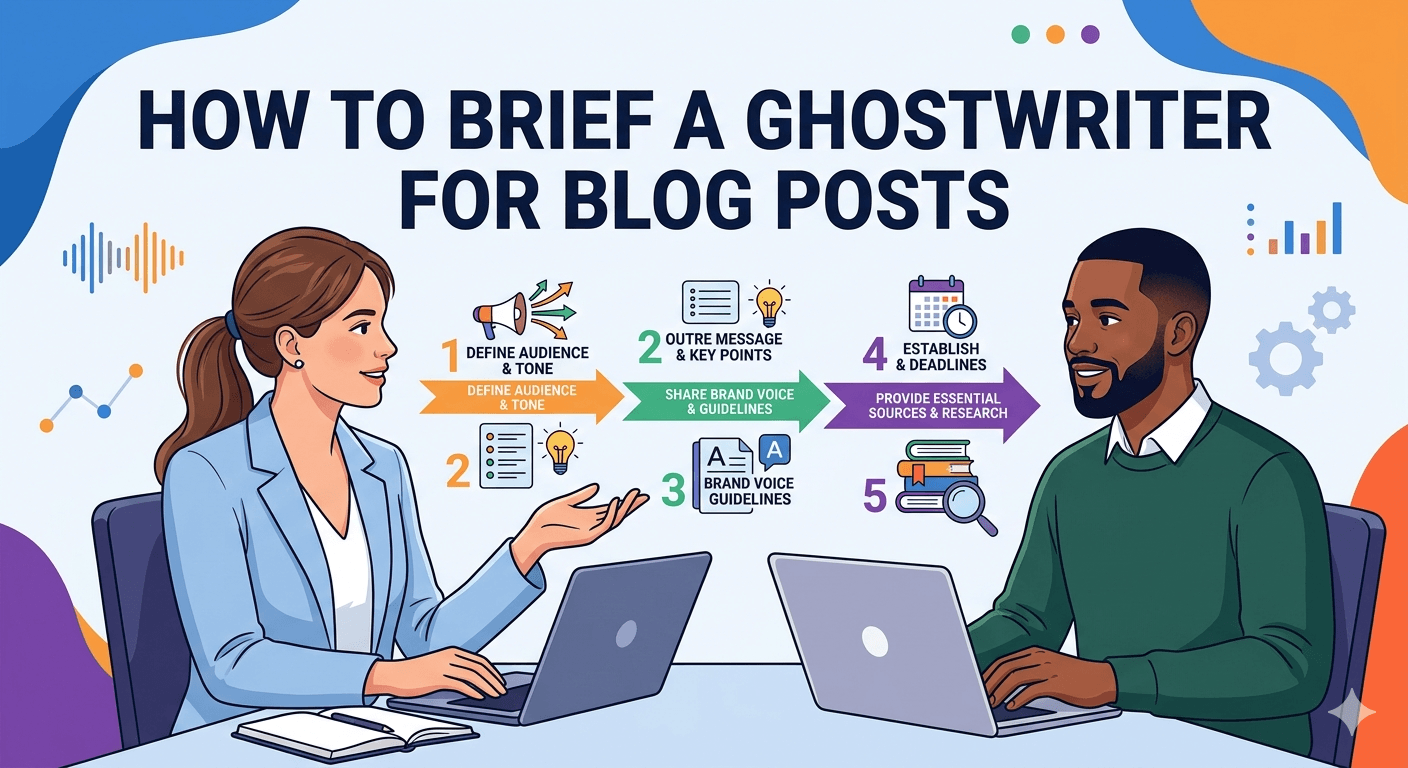
One of the most common anxieties before hiring a content ghostwriter is not about finding the right person — it is about knowing what to say once you have found them.
“I am not sure I can explain what I want.” “I do not know how to describe my voice.” “What if I give them the brief and they still write something that sounds nothing like me?”
These worries are completely understandable. Briefing a ghostwriter well is a genuine skill — and nobody teaches it. Most people hand over a rough topic idea and hope for the best, then spend hours revising work that was always going to need significant changes because the brief was too thin.
This article fixes that. It covers the six essential elements of a ghostwriting brief, how to describe your voice when you have never had to articulate it before, what to include in your reference articles, and how to handle the brief conversation in a way that consistently produces strong first drafts.
At the bottom, you will find Verity’s free ghostwriting brief template — a fillable document you can use immediately for any blog post, article, or newsletter piece.
Why the Brief Is Your Most Important Tool
Here is something most clients do not realise until they are already deep into a content ghostwriting relationship: the quality of the first draft is almost entirely determined by the quality of the brief.
A skilled ghostwriter working from a rich, specific brief will produce a first draft that sounds like you, covers the right ground, and needs only light revision. The same skilled ghostwriter working from a thin brief will produce a competent but generic piece that requires significant rewriting — not because they lack skill, but because they did not have the information they needed.
The brief is not about controlling the ghostwriter. It is about giving them what they need to produce work that is genuinely yours rather than a professionally written placeholder.
The Six Elements Every Brief Must Include
1. The Audience — Be Specific, Not General
“My audience is entrepreneurs” is not useful. “My audience is early-stage founders of B2B SaaS companies, typically aged 28 to 45, who have raised their first round of funding and are trying to build their first sales team” is useful.
The more precisely your ghostwriter understands who they are writing for, the better they can calibrate the language, the assumed knowledge level, the examples, and the tone. A piece written for first-time founders looks completely different from a piece written for serial entrepreneurs — even if the topic is identical.
Include what your reader already knows about the subject — so the ghostwriter does not waste words on basics your audience finds patronising — and what keeps them up at night, so the piece speaks to what actually matters to them.
2. The Core Message — One Sentence
Every article should have a single core message: the one thing you want the reader to walk away with. Not five things. One.
This is harder than it sounds, which is partly why so many ghostwritten articles feel vague or meandering — the brief contained a general topic but not a specific point of view. “Write about leadership” produces a different article from “Write about why the advice to hire people smarter than you is actually a trap for first-time managers and what to do instead.”
Before you submit any brief, write this sentence: “After reading this article, my reader will understand that ___.” If you cannot complete it with something specific, the brief needs more work.
3. Your Voice — The Hardest Part to Describe
Voice is what makes a ghostwritten article feel like you rather than like a professional writer approximating you. And it is the element most clients find hardest to articulate.
A few approaches that work well:
Share reference articles. Find two or three pieces — ideally ones you have written yourself, or published articles whose tone feels right — and share them with your ghostwriter. Tell them specifically what you like about each one. “This one gets the balance between confident and approachable right.” “This one uses humour in a way that feels natural rather than forced.” “I like how direct this one is — it does not hedge everything.”
Describe what you are not. Sometimes the most useful thing is to articulate the opposite of your voice. “I am not academic or formal.” “I do not use jargon.” “I never sound tentative or overly qualified.” “I hate content that feels like it was written to please an algorithm rather than an actual person.” Negative descriptions often produce clearer calibration than positive ones.
Share your own writing. Emails, presentations, previous articles, social media posts — give your ghostwriter as much of your natural writing as you can. The patterns in how you write when you are not thinking about it are the most accurate representation of your voice.
Describe your register. Are you direct and opinionated? Warm and conversational? Formal and authoritative? Pragmatic and data-driven? A simple three-word description — “direct, practical, slightly irreverent” — gives a ghostwriter a useful starting point even before they see any samples.
4. The Key Points — What the Article Must Cover
List the specific points, arguments, examples, or data you want included. Not a full outline — just the things the piece must contain, in your words, before the ghostwriter structures them into a coherent article.
Include your own examples and stories here. This is the element most clients skip, and it is the one that most directly determines whether the finished article sounds like you or like a generic professional writer. Your personal experiences, your specific opinions, the client story that illustrates your point — these are what transform a competent blog post into a piece that sounds unmistakably like you.
If there are things the article should not cover — common misconceptions you want to push back on, competitor approaches you want to avoid referencing, aspects of the topic that are out of scope — include those too.
5. The SEO Target — Keyword and Search Intent
For blog posts specifically, your ghostwriter needs to know the primary keyword you are targeting and — more importantly — the search intent behind it. “What is my reader trying to accomplish when they search this term? Are they looking for an answer, a comparison, a how-to guide, a list?”
Understanding search intent changes the entire structure of an article. A piece targeting “how to manage a remote team” needs to be different from a piece targeting “remote team management challenges” — even though they are adjacent topics. One is looking for a how-to guide; the other is looking for commiseration and solutions.
Also tell your ghostwriter whether SEO is the primary purpose of the article or secondary. If you are writing primarily for an existing audience and SEO is incidental, that changes the approach significantly.
6. Practical Specifications
Length, format, CTA, internal links — these are practical details that should be in every brief.
How long should the article be? What format — listicle, how-to, opinion piece, case study, narrative? Is there a call to action and if so what is it — subscribe, book a call, download a resource? Are there specific internal links you want included? Are there any external sources the ghostwriter should draw on or avoid?
How to Handle the Brief Conversation
For most content ghostwriting relationships, the brief starts as a document you fill in — but the best client-ghostwriter relationships quickly evolve into a faster, more instinctive exchange.
In the early weeks, expect your ghostwriter to ask follow-up questions on every brief. This is a good sign, not a bad one. It means they are investing in understanding your voice properly rather than making assumptions. Answer those questions fully. The richer your responses, the faster the voice calibration happens.
By the third or fourth article, the questions should get shorter. By the tenth, a brief that would have taken you 20 minutes at the start of the relationship may take five. That compounding efficiency is one of the most valuable things a sustained content ghostwriting relationship produces.
What Good Looks Like vs What Does Not
Brief that will produce a generic article:
“Please write a 1,000-word blog post about leadership for my audience of business owners. Tone: professional but approachable.”
Brief that will produce a strong first draft:
“Please write a 1,200-word article for early-stage founders (first or second company, 5–20 employees) titled something like ‘The Leadership Advice That Nearly Sank My Company.’ Core message: The advice to ‘trust your gut’ is genuinely dangerous before you have enough data to know what your gut is calibrated against. I want to use the example of my first hire — I was so convinced they were right that I ignored every objective signal — to illustrate the point. Tone: honest, slightly self-deprecating, confident by the end. Voice reference: my LinkedIn post from January about decision-making under uncertainty — that tone is exactly right. SEO: targeting ‘leadership mistakes first-time founders’ with informational intent. CTA: link to the free founder guide at the bottom.”
The difference in the first drafts those two briefs produce is enormous — and it has nothing to do with the ghostwriter’s skill.
Free Ghostwriting Brief Template
Use this template for every blog post, article, or newsletter piece you commission. Copy it into a Google Doc, fill it in, and share it with your ghostwriter.
VERITY GHOSTWRITING — CONTENT BRIEF TEMPLATE
Article title or working title:
Target audience: (Who specifically is reading this? What do they already know? What keeps them up at night?)
Core message: (Complete this sentence: “After reading this article, my reader will understand that ___.”)
Key points to cover: (List the specific arguments, examples, data, or stories you want included. Include your own personal examples where relevant.)
Things to avoid: (Topics, approaches, common misconceptions, or competitor references to exclude.)
Voice and tone: (Describe in three words. Link to two or three reference articles. Describe what you are NOT.)
Primary keyword:
Search intent: (What is the reader trying to do when they search this term? How-to, comparison, answer a question, find inspiration?)
Target word count:
Format: (How-to, listicle, opinion, narrative, case study — or a combination?)
Call to action: (What do you want the reader to do after reading?)
Internal links to include:
External sources to draw on or avoid:
Any other context: (Deadline, publication platform, related articles in the series, anything else the ghostwriter should know.)
Frequently Asked Questions
How detailed does a ghostwriting brief need to be?
Detailed enough that your ghostwriter could write a strong first draft without asking you any questions at all — even if in practice they will still ask a few. The brief should cover who the reader is, what the article’s core message is, which specific points and examples to include, what your voice sounds and does not sound like, and all practical specifications. A brief that takes you 15 to 20 minutes to fill in will consistently produce better first drafts than one that takes two minutes.
What if I do not know how to describe my voice?
Start with what it is not. “Not academic, not formal, not hedged, not algorithm-friendly” gives a ghostwriter a clearer calibration target than a vague positive description like “friendly and professional.” Then share three to five examples of writing whose tone you want to emulate — your own previous articles, published pieces you admire, or even a particularly good email you wrote. Voice is easier to show than describe.
How many reference articles should I share?
Two to three is usually enough. The goal is to give your ghostwriter a consistent picture of the voice and register you are aiming for — not an exhaustive library. If the reference articles you share have very different tones from each other, add a note explaining what specifically you like about each one so the ghostwriter knows which elements to take from each.
What happens if the first draft does not match the brief?
Tell your ghostwriter specifically where it diverged from your expectations. “The tone is more formal than the reference articles I shared” or “you did not include the story about the failed hire that I mentioned in the key points” is far more useful feedback than “this does not sound like me.” Specific feedback calibrates the ghostwriter’s model of your voice precisely — vague feedback does not.
Ready to Start?
At Verity Ghostwriting, we help entrepreneurs, executives, coaches, and thought leaders produce blog content, articles, and newsletters that sound authentically like them — consistently, at scale. Our onboarding process includes a voice calibration session specifically designed to get your brief template right from the start.


