

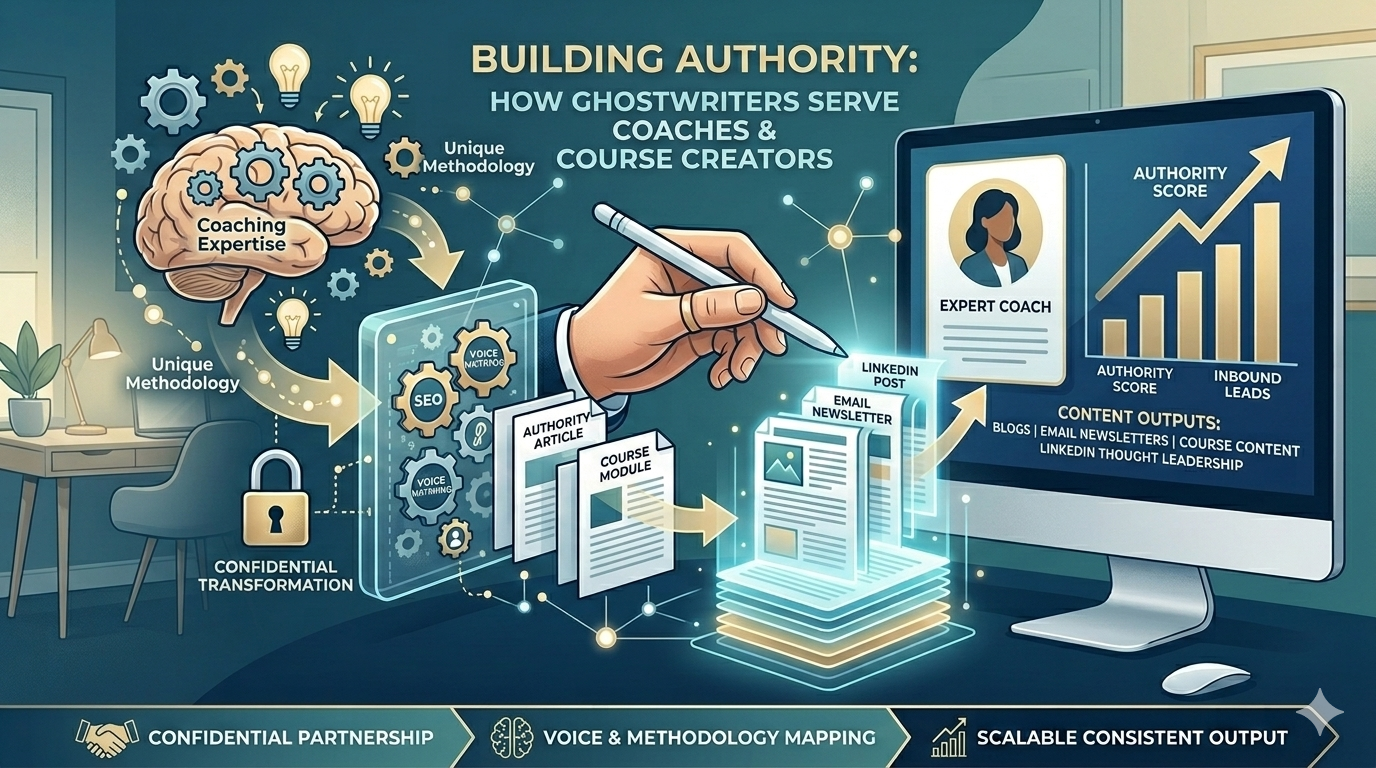
| TL;DR Coaches and course creators use ghostwriters to produce the consistent, high-quality content their authority-based businesses depend on — without writing it themselves. A ghostwriter for coaches learns the coach’s methodology, voice, and audience, then produces blog posts, email newsletters, LinkedIn content, and course materials that sound authentically like the coach and position them as the go-to expert in their niche. The arrangement is legitimate, confidential, and widely used among successful online educators and coaching professionals. |
There is a particular tension at the heart of most coaching and course creation businesses. Your entire revenue model depends on being perceived as an authority — someone who knows more, thinks more clearly, and communicates more effectively than anyone else in your niche. But demonstrating that authority requires a constant output of content: blog posts, email sequences, LinkedIn articles, social posts, course modules, lead magnets, newsletters.
The people who are most qualified to produce that content — coaches and course creators with genuine expertise, real client results, and a distinctive methodology — are also the people with the least time to write it. They are coaching. They are creating. They are building programmes, running cohorts, managing communities, and doing the work that their clients actually pay for.
This is the gap that ghostwriting fills. And it is a gap that an increasing number of successful coaches and course creators have quietly closed — not by pretending to write more than they do, but by working with professional ghostwriters who learn their voice, understand their methodology, and produce content that sounds like them at their most articulate.
This article explains exactly how ghostwriting works for coaches and course creators, what content types it covers, how to find the right ghostwriter, and how to structure the relationship so that your content actually builds authority rather than just filling publishing slots.
Why Content Is Non-Negotiable for Coaches and Course Creators
In almost every coaching and course creation business, content does three jobs simultaneously — and none of them are optional.
It proves expertise before a prospect spends money
A prospective client or student does not know whether your methodology works. They cannot verify your claims from a sales page alone. What they can do is read your blog, scroll your newsletter, watch your videos, and form an opinion about whether you actually know what you are talking about. Content is the proof that earns trust before a transaction. In a market crowded with coaches and course creators making similar claims, the quality and consistency of your content is often the deciding factor.
It attracts the right audience through search and social
High-quality blog content builds organic search visibility over time. A coach who consistently publishes well-researched, genuinely useful articles on their area of expertise will attract prospective clients who are actively searching for solutions — the highest-intent audience available. This is compounding, not transactional: every article published builds on the last, and the authority signal grows month over month.
It nurtures prospects through a longer decision cycle
Coaching and course buying decisions are rarely impulsive. Prospects often spend weeks or months reading your content, receiving your emails, and observing your thinking before they decide to invest. A consistent content presence keeps you visible and trusted throughout that decision cycle. Silence — a blog that has not been updated in three months, an email newsletter that has gone quiet — creates doubt exactly when you need confidence.
| The authority paradox
The people most qualified to produce authority-building content are the ones with the least time to write it. The more successful a coach or course creator becomes, the more demand there is on their time — and the harder it becomes to maintain the consistent content output that got them there. Ghostwriting is how successful knowledge entrepreneurs resolve this paradox. |
What Types of Content Do Coaches Use Ghostwriters For?
Ghostwriting for coaches and course creators covers every written format their business depends on. Here is a practical breakdown of the most common content types and what ghostwriting adds to each.
| Content type | What a ghostwriter produces | Why coaches outsource this |
| Blog posts and articles | Long-form, SEO-optimised articles in the coach’s voice targeting relevant keywords | Time-intensive to produce; requires both writing skill and SEO knowledge |
| Email newsletters | Regular newsletters that maintain audience engagement and nurture prospects | Demands consistent creative output that coaches struggle to sustain alongside client work |
| LinkedIn content | Posts, articles, and thought leadership content for professional audiences | High-value channel that requires frequent, polished output to build traction |
| Course content and scripts | Module scripts, workbook copy, video narration text, lesson frameworks | Writing for learning formats is a specific skill distinct from coaching itself |
| Lead magnets and opt-ins | Guides, checklists, and downloadable resources that build email lists | Strategic content requiring writing craft and understanding of conversion |
| Sales page copy | Long-form sales pages for programmes, courses, and coaching packages | Specialist copywriting skill that few coaches have developed themselves |
| Case studies and testimonial writeups | Structured client success stories that demonstrate results | Requires interview skills and the ability to shape a narrative around outcomes |
How a Ghostwriter Learns a Coach’s Voice and Methodology
The most common concern coaches raise about ghostwriting is voice authenticity. If someone else is writing your content, how can it possibly sound like you? The answer lies in the process — and it is more sophisticated than most people expect.
The voice mapping process
Professional ghostwriters for coaches begin with an extended intake and interview process specifically designed to capture the coach’s voice, language patterns, and intellectual style. This typically involves:
- Reviewing existing content. Any blog posts, social media content, emails, or programme materials the coach has already produced give the ghostwriter a window into how they naturally communicate.
- Recorded voice sessions. The ghostwriter conducts audio or video conversations with the coach — asking them to explain their methodology, tell client stories, and articulate their perspective on key topics in their niche. These recordings capture the coach’s natural language patterns, the examples they reach for, and the pace and rhythm of their thinking.
- Vocabulary and concept mapping. Most coaches have a distinctive vocabulary — specific terms, frameworks, analogies, and phrases that are characteristic of their approach. The ghostwriter documents these and uses them consistently across all content.
- Calibration through early drafts. The first two or three pieces produced are explicitly treated as calibration exercises. The coach reviews them carefully and provides specific feedback — what sounds right, what sounds off, what is missing. This calibration shapes all subsequent content.
Capturing methodology, not just words
A ghostwriter who only captures how a coach writes is producing surface-level voice-matching. A ghostwriter who understands how a coach thinks — their framework for understanding their clients’ problems, their distinctive perspective on their field, the specific transformation their work produces — is producing content that is genuinely representative of the coach’s intellectual contribution.
This depth of understanding takes time to develop. It is why the most effective coaching ghostwriting relationships are ongoing rather than transactional — the ghostwriter’s understanding of the coach’s methodology and voice compounds over months and years, producing content that becomes more precisely representative with each piece.
The Business Case for Ghostwriting as a Coach
Let us be direct about the economics. Ghostwriting for coaches is a significant investment. The question is whether it is a good one — and for most coaching and course creation businesses operating at a meaningful scale, the answer is clearly yes.
The opportunity cost of writing your own content
A coaching hour — the hour you spend coaching a client — has a specific monetary value. For many coaches, that value is between $200 and $1,000 or more per hour, depending on the programme and the client. Every hour you spend writing a blog post is an hour not spent coaching, not spent developing your programme, not spent on the high-leverage activities that actually grow your business.
The calculation is straightforward: if a ghostwriter can produce a blog post for $400 that would take you four hours to produce yourself — four hours that you could otherwise spend coaching at $300 per hour — the ghostwriter pays for itself before the article is published.
The compounding value of consistent content
Inconsistent content — three blog posts published in January, nothing in February and March, two in April — builds essentially no authority and generates essentially no organic traffic. The algorithm does not reward intermittency. Neither do prospective clients who visit your blog and find the last post is six months old.
Consistent content — one to two high-quality posts per week, published reliably over 12 to 18 months — compounds. Rankings improve. Topical authority builds. The audience grows. Inbound enquiries increase. A ghostwriter makes consistency possible in a way that self-produced content rarely achieves for a busy coaching professional.
The positioning premium
Coaches with a robust, consistently updated content library command a positioning premium over coaches with a thin or absent content presence. Prospects perceive them as more established, more credible, and more worth paying for. This positioning effect is difficult to quantify precisely — but it is real, and it compounds over time in the same way that authority does.
| Writing your own content | Outsourcing to a ghostwriter |
| 4 to 8 hours per week on writing | 30 to 60 minutes per week on review and feedback |
| Inconsistent output — dependent on available time and energy | Consistent output — on a planned publishing schedule |
| Quality varies with your energy and writing confidence | Professional standard, editorially reviewed, every piece |
| Strategic thinking about content often skipped | Content strategy built into the programme from day one |
| Cannot easily scale without reducing quality | Can scale volume without additional time from the coach |
| High opportunity cost in coaching hours foregone | Investment paid for by recovered coaching hours |
Ghostwriting for Course Creators: Specific Considerations
Course creation involves a content category that is distinct from marketing content — the learning content itself. Scripts, workbooks, lesson frameworks, video narration, and module copy all require a different kind of writing than a blog post or newsletter, and ghostwriting for this type of content has its own set of considerations.
Writing for learning, not reading
Course content is designed to produce a specific learning outcome — a skill acquired, a concept understood, a behaviour changed. Writing that is excellent for a blog post may be poor for a course module. A ghostwriter producing course content needs to understand instructional design principles: how to sequence information for learning, how to combine explanation with practice, how to pace content for engagement, and how to write in a way that translates well to video narration.
Capturing the coach’s teaching style
Every coach teaches differently. Some use structured frameworks. Some teach through story. Some use Socratic questioning. Some use a combination of all three. A ghostwriter producing course content must capture not just the coach’s voice but their teaching style — the specific pedagogical approach that their clients enrolled in the course to experience.
The scripts-versus-slides decision
Many course creators use ghostwriters to produce either full video scripts or detailed speaker notes that they then record in their own words. Both approaches have merit. Full scripts produce more polished, consistent video content — but require the creator to be comfortable reading from a script without sounding scripted. Speaker notes give more flexibility — the creator talks naturally over a structure the ghostwriter has built. The right approach depends on the creator’s delivery style and the course format.
How to Find a Ghostwriter Who Understands the Coaching Industry
Not all ghostwriters are equipped to write for coaches and course creators. The coaching industry has a specific vocabulary, a specific audience psychology, and a specific content purpose that requires familiarity to navigate well. Here is how to find someone who genuinely understands this context.
What to look for
- Samples in the coaching or online education niche. Ask to see examples of blog posts, newsletters, or course content written for coaches, consultants, or online educators. Generic content writing samples — even very good ones — do not demonstrate the specific capability you need.
- Understanding of coaching business models. A ghostwriter who understands how a coaching business generates leads, nurtures prospects, and converts clients will make fundamentally different content decisions from one who does not. Ask them to explain how they would approach content strategy for a coaching business.
- Experience capturing non-writers’ voices. Most coaches are excellent communicators but not trained writers. The ghostwriter you hire needs experience extracting compelling content from people who think in conversations rather than paragraphs. Ask how they conduct their voice sessions and how they handle clients who struggle to articulate their ideas in writing.
- References from coaching or knowledge business clients. Ask for references specifically from coaches, consultants, or course creators — not just from generic content writing clients.
What to ask in the discovery conversation
Before hiring any ghostwriter for your coaching business, the conversation should cover at minimum the questions in our guide to 10 questions to ask before you hire a ghostwriter. For coaches specifically, add these:
- How do you approach learning a methodology you have not worked with before?
- How do you handle content that requires specific expertise — case studies, research references, technical concepts from my coaching framework?
- How many coaching or consultant clients have you worked with, and what types of content did you produce for them?
- If I give you a 30-minute recording of me explaining a concept, what does that produce and in what timeframe?
Setting Up the Ghostwriting Relationship for Long-Term Success
The coaches and course creators who get the most from a ghostwriting relationship are the ones who set it up thoughtfully from the start. Here is what that looks like in practice.
Create a comprehensive onboarding document
Before your ghostwriter writes their first word for you, produce a document that covers: your target audience and their specific problems, your coaching methodology and key frameworks, the vocabulary and terminology specific to your approach, the content topics you want to own and the ones you want to avoid, examples of content you admire and why, your tone guidelines, and your business objectives for the content. This document becomes the ghostwriter’s reference for every piece they write.
Front-load the interview time
The most valuable investment you will make in the ghostwriting relationship is time spent in the early interview sessions. These sessions are where the ghostwriter captures the raw material — your stories, your case studies, your frameworks, your perspective — that will be translated into content for months or years. Take these sessions seriously, come prepared, and do not rush them.
Establish a content strategy before individual briefs
A content strategy defines which keywords you are targeting, which topics you are establishing authority on, how individual pieces link together, and how your content supports specific business objectives. Individual briefs make much more sense — and produce much better articles — when they exist within a coherent strategy. If your ghostwriter or agency does not propose building a strategy before writing begins, ask for one.
Review early pieces carefully and specifically
Your feedback on the first three to five pieces you receive is the most important feedback in the entire relationship. Read them carefully against your voice — not just against whether you like them, but against whether they sound like you, reflect your methodology accurately, and speak to your audience in the right way. Specific feedback here calibrates the ghostwriter faster and reduces revision cycles for all subsequent content.
Plan to publish consistently from day one
Ghostwriting produces its greatest value when it enables consistent publishing. Establish a publishing calendar from the start — how many pieces per month, on which days, across which platforms — and treat it as a commitment. Inconsistent publishing wastes the investment and undermines the compounding authority effect that consistent content builds.
Frequently Asked Questions
Can a coach ethically use a ghostwriter for their content?
Yes. Ghostwriting is a legitimate, widely used professional practice in the coaching industry and beyond. The ideas, methodology, and expertise in every piece of ghostwritten content are genuinely the coach’s. The ghostwriter provides the writing craft and consistency the coach cannot produce alone. This is no different from a coach using a graphic designer for visual content, a virtual assistant for administrative work, or an editor for their programme materials. For the full legal and ethical analysis, see is ghostwriting legal?.
Will my audience be able to tell my content is ghostwritten?
Not if your ghostwriter is doing their job well. A professional ghostwriter captures your specific voice — your vocabulary, tone, the examples you naturally use, the way you structure an argument — and maintains it consistently across every piece. Most coaches report that readers, clients, and colleagues cannot tell the difference. Some report that their ghostwritten content is cleaner and more articulate than what they produce themselves — which reflects that the ghostwriter is capturing their thinking at its best, not replacing it.
How much does a ghostwriter for coaches cost?
Ghostwriting for coaches varies significantly by scope and quality. Individual blog posts from professional ghostwriters range from $350 to $800 per article. Monthly content retainers covering multiple blog posts, a newsletter, and LinkedIn content typically range from $1,500 to $4,000 per month depending on volume and the level of strategy included. Course content and scripts are typically priced per module or per project rather than per article. The right investment depends on what the content needs to achieve and what your coaching time is worth.
How do I give a ghostwriter my ideas if I don’t have time to write?
The most effective method is recorded audio or video conversations. Spend 20 to 30 minutes talking through the key idea for an article — explaining it as you would to a coaching client — and send the recording to your ghostwriter. They transcribe, extract the key ideas, structure them into an article outline, and produce a draft that captures your natural explanation. Many coaches find this dramatically more efficient than trying to write from a blank page, and the resulting articles often feel more authentically like their spoken voice than anything they produce by sitting down to write.
Can a ghostwriter help me create my online course content?
Yes — and this is a growing area of ghostwriting work for coaches and course creators. A ghostwriter with experience in learning content can produce module scripts, workbook copy, video narration text, lesson frameworks, and quiz content in your voice and consistent with your teaching methodology. The key is finding a ghostwriter who understands instructional design as well as editorial writing — not all do, so ask specifically about their experience with course content.
How long does it take to get a blog post from a ghostwriter?
A standard 1,500 to 2,000-word blog post typically takes five to seven business days from brief approval to first draft delivery. More research-intensive articles or longer pieces take proportionally longer. In an ongoing retainer arrangement, a production calendar is established at the start — so you know exactly when each piece will arrive and can plan your publishing schedule accordingly. For a full timeline breakdown across different content types, see the article on how long it takes to ghostwrite a book.
Should I hire a ghostwriting agency or a freelance ghostwriter for my coaching business?
For coaches with a significant content programme — regular blog posts, a newsletter, LinkedIn content, and potentially course materials — a ghostwriting agency typically offers better continuity, editorial oversight, and strategic capability than a solo freelancer. If your needs are more limited — one to two blog posts per month with a consistent voice — a skilled freelance ghostwriter may be the more efficient choice.
What is the first step to hiring a ghostwriter for my coaching business?
Start with a discovery conversation — a call in which you explain your coaching business, your target audience, the content you want to produce, and what you need it to achieve. A good ghostwriter or ghostwriting agency will give you an honest assessment of whether they are the right fit, recommend a content approach, and outline what the engagement would look like before any commitment is required.


