

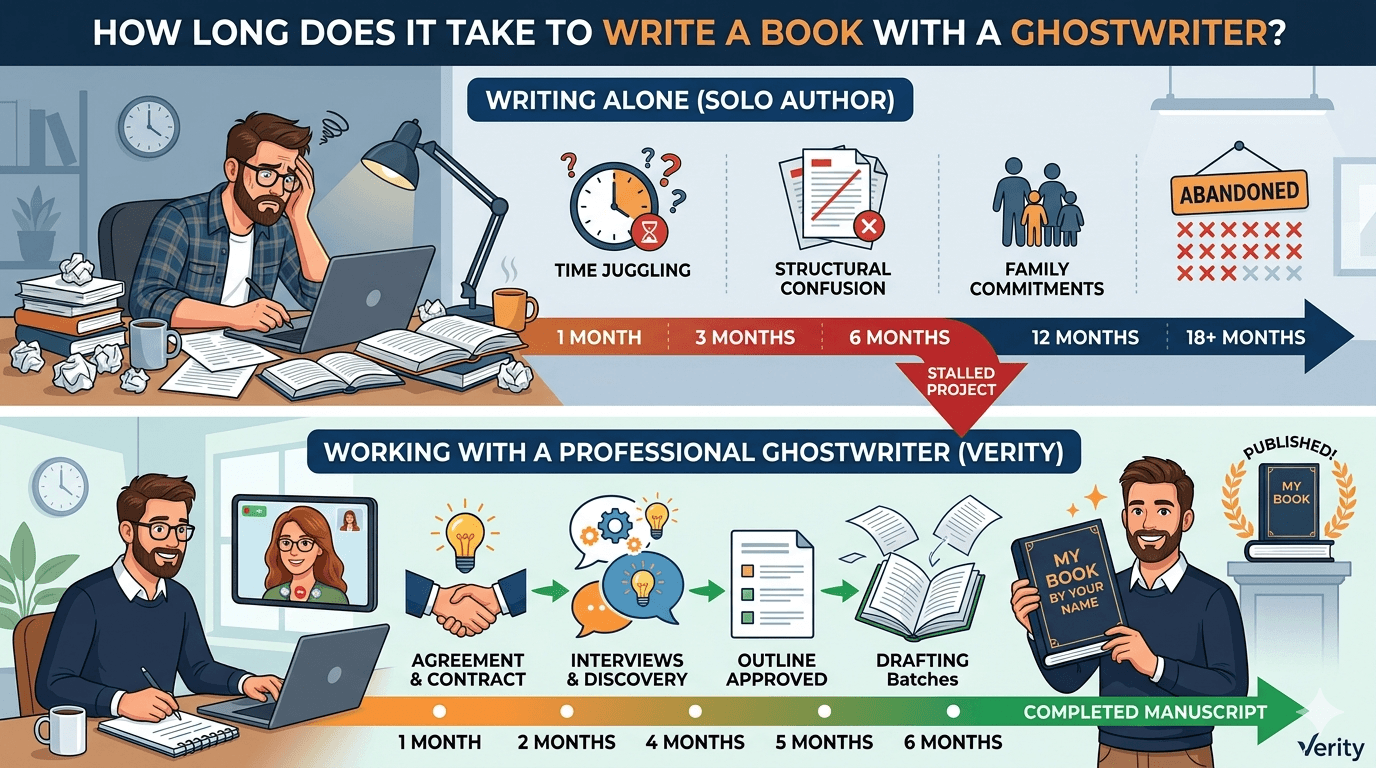
Timeline is the question that stops more book projects before they start than any other. Not the cost. Not the process. The timeline. People hear ‘writing a book’ and imagine years of solitary struggle — and they are right, if they are writing it themselves.
Writing a book solo typically takes anywhere from six months to several years. First-time authors juggling a day job and family commitments often find themselves in the twelve-to-eighteen-month range for a completed draft — and that is before revisions. Deeply researched non-fiction or complex narrative projects routinely stretch to two years or more. Even experienced authors writing full-time rarely finish a polished manuscript in under three months.
With a professional ghostwriter, the maths change significantly. A book that might take an individual two to three years to produce on their own — squeezed between client work, family, and everything else — typically takes four to nine months when handled by an experienced ghostwriting team. A professional ghostwriter producing at pace can complete a 60,000-word first draft in roughly six weeks of active drafting. Your involvement is real, but it is structured, bounded, and a fraction of what solo writing demands.
This article gives you a clear, honest picture of what to expect: how long writing a book takes with and without a ghostwriter, realistic timelines by book type, what speeds projects up or slows them down, and how to set your project up for the fastest possible path from idea to finished manuscript.
| Quick Answer
Writing a book yourself takes 6 to 18 months on average — and most first attempts are never finished. Working with a professional ghostwriter compresses that to 4 to 9 months, with your personal time commitment reduced to around 30 to 50 hours across the entire project. The biggest variable is not the ghostwriter — it is how quickly you can provide interviews, feedback, and approvals. |
How Long Does It Take to Write a Book? (The Solo Reality)
Before we get into ghostwriting timelines, it is worth grounding the comparison in honest numbers for solo authors — because the gap between expectation and reality is significant, and it explains why so many people eventually look for a better route.
| Writing Pace | Solo Author Scenario | Estimated Timeline |
| Fast | Experienced author, writing full-time, clear outline | 1 to 3 months for a first draft |
| Realistic average | First-time author, part-time writing, moderate research | 6 to 12 months for a first draft |
| Slow | Busy professional, irregular writing, heavy research or complex subject | 1 to 3 years to completion |
| Never finished | Most common outcome for first-time authors | Indefinite — project abandoned |
The pace at which you write matters too. An author consistently producing 500 words a day can complete a 60,000-word first draft in roughly five months. At 1,000 words a day — a demanding but achievable pace for a focused writer — that drops to around two and a half months. The challenge for most professionals is that consistent daily writing is extraordinarily difficult to sustain alongside a full working life.
This is where ghostwriting changes the equation entirely. The ghostwriter does the daily writing. You do the thinking, the talking, and the reviewing.
Timeline by Book Type: What to Realistically Expect
Different books take different amounts of time, for reasons that go beyond word count. A business book with a clear argument and a structured framework moves faster than a memoir that requires extended reflection and careful voice-matching. Here is an honest breakdown across the most common book types.
| Book Type | Typical Word Count | Ghostwriting Timeline |
| Short business book or manifesto | 25,000 – 40,000 words | 3 to 4 months |
| Standard business or non-fiction book | 45,000 – 65,000 words | 4 to 6 months |
| Memoir or personal narrative | 60,000 – 85,000 words | 5 to 8 months |
| Leadership or thought leadership book | 40,000 – 60,000 words | 4 to 6 months |
| Biography (subject still living) | 60,000 – 90,000 words | 6 to 10 months |
| Complex research-heavy non-fiction | 70,000 – 100,000 words | 8 to 12 months |
| Rush project (expedited timeline) | Any length | Timeline halved; premium rates apply |
These timelines assume a professional ghostwriter working full-time on your project, a client who is available for interviews and provides feedback within a reasonable window, and a scope that does not expand significantly after the outline is approved. Any of those variables can shift the timeline — in either direction.
A Realistic Month-by-Month Project Map
To make these timelines concrete, here is what a typical five-month ghostwriting project actually looks like — a standard business or non-fiction book of around 50,000 words.
| Month | What Happens |
| Month 1 — Discovery and Briefing | Initial discovery call; scope and contract agreed; onboarding completed; first voice sessions and interviews recorded (3 to 5 hours of your time) |
| Month 2 — Research, Interviews and Outline | Further interviews conducted (4 to 8 hours); ghostwriter develops full chapter-by-chapter outline; you review and approve the outline with any revisions |
| Month 3 — First Draft Begins | Ghostwriter begins drafting; first 2 to 3 chapters delivered for your review; feedback incorporated before moving forward |
| Month 4 — Drafting Continues | Remaining chapters drafted and delivered in batches; you review each batch and provide feedback; voice adjustments made in real time |
| Month 5 — Revisions and Final Manuscript | Full first draft complete; consolidated revision round based on your notes; final manuscript delivered in agreed format |
This is a smooth project with a responsive client. Add a month if feedback rounds take longer than a week, or if the scope expands during drafting. Subtract a month if the subject matter is tightly focused and you come to interviews with strong, clear material.
What Slows Projects Down — and How to Avoid It
In fifteen years of professional ghostwriting, the same factors appear in every delayed project. None of them are the ghostwriter’s fault. Almost all of them are avoidable with a little planning.
Slow feedback on draft chapters
This is the single most common cause of project delays. When a ghostwriter delivers a chapter batch and waits two or three weeks for a response, momentum breaks and timelines slip. The fix is simple: block time in your calendar to review draft material within five to seven days of receipt. Treat it like a client deadline, because it is one.
Unavailability for follow-up interviews
Ghostwriters frequently need to come back with specific questions as they draft — a date they need confirmed, a story they want to expand, a detail that would strengthen an argument. If you are unreachable for weeks at a time, the ghostwriter cannot move forward without risk of getting something wrong. Designate a preferred communication channel and commit to responding within 48 hours during the active drafting period.
Scope creep after the outline is approved
The outline stage exists precisely to prevent this. Once the chapter structure, key arguments, and major stories are agreed upon, adding new chapters, expanding the scope, or fundamentally changing the book’s direction mid-project is expensive in both time and money. Invest the time upfront to get the outline right. Changes at the outline stage cost you an hour. Changes at the draft stage cost you weeks.
Unclear or conflicting feedback
Feedback like ‘this doesn’t feel quite right’ without any further direction puts a ghostwriter in a difficult position. The most useful feedback is specific: which part feels off, what it should say instead, what the intended effect on the reader is. If you are not sure how to articulate feedback, a quick call is almost always faster than written notes.
Personal circumstances and interruptions
Life happens. Projects get paused for health issues, business crises, family events, and a hundred other legitimate reasons. The best ghostwriting contracts include provisions for project pauses so that a temporary interruption does not derail the whole engagement. If you know your availability will be patchy during a particular period, communicate that upfront and build it into the timeline.
Your Role in the Timeline: What You Actually Need to Contribute
One of the most common misconceptions about ghostwriting is that handing the project to a ghostwriter means handing over all responsibility. It does not. A ghostwriter writes the book, but they cannot do it well without your active involvement. Here is exactly what that looks like in practice.
| Your Contribution | Realistic Time Required |
| Discovery and briefing sessions | 2 to 4 hours (front-loaded in Month 1) |
| Voice and content interview sessions | 8 to 15 hours (spread across Months 1 and 2) |
| Outline review and approval | 1 to 3 hours |
| Chapter batch review and written feedback | 1 to 2 hours per batch (4 to 6 batches typical) |
| Follow-up questions and clarifications | 30 to 60 minutes per week during active drafting |
| Final manuscript read-through | 4 to 8 hours |
| Total across a 5-month project | Approximately 30 to 50 hours |
Thirty to fifty hours over five months is six to ten hours a month — roughly two hours a week. For most business owners, coaches, and executives, that is genuinely manageable alongside a full schedule. The key is that this time is concentrated and purposeful, not scattered. You are not writing — you are being interviewed, reviewing, and approving. Those are very different cognitive demands.
Factors That Speed a Project Up
Just as certain things slow a project down, specific conditions allow ghostwriting projects to move faster than average — sometimes significantly.
- You come prepared to interviews. Clients who think through their key stories, examples, and arguments before each session give the ghostwriter richer, more usable material in less time. Ten minutes of preparation before an interview can save an hour of follow-up.
- You have existing written material. Articles, speeches, presentations, email newsletters, course content — anything you have already produced is a goldmine for a ghostwriter. It reveals your voice, your thinking patterns, your examples, and your frameworks without requiring an interview.
- The book’s scope is clearly defined before work begins. Projects with a tight, well-defined brief move significantly faster than those where the scope evolves during drafting. The more specific the outline, the less back-and-forth during the writing phase.
- You have a dedicated point of contact. If you have a team, designating one person to handle scheduling, document sharing, and communication with the ghostwriter eliminates friction and keeps things moving.
- You respond to drafts quickly and specifically. Clients who review chapters promptly and give clear, actionable feedback compress the revision cycle dramatically. The difference between a one-week and a three-week feedback window across six chapters is a month of project time.
Rush Projects: Can You Get a Book Done Faster?
Yes — but with important caveats. Rush ghostwriting is possible, and some agencies, including Verity, can accommodate expedited timelines for certain projects. The trade-offs are real, and you should understand them before deciding whether a rush timeline is worth it.
What ‘rush’ actually means
A rush project typically means compressing a four-to-six-month timeline into two to three months. This requires the ghostwriter to prioritise your project above others, often working extended hours, and demands a higher level of availability and responsiveness from you. Interview sessions happen more frequently and more intensively. Feedback turnarounds need to be 24 to 48 hours, not five to seven days.
The cost premium
Rush timelines command a significant premium — typically 30 to 60 per cent above standard rates. This reflects the opportunity cost of the ghostwriter dedicating concentrated time to your project at the expense of others, and the higher intensity of work required to maintain quality at speed.
When is rush worth it
- You have a speaking engagement, media appearance, or event where the book needs to be available.
- A time-sensitive business opportunity depends on having a published book.
- A competitor is about to publish on the same topic, and you need to move first.
- You have a launch campaign planned around a fixed date that cannot be moved.
When rush is not worth it
If the reason for rushing is simply impatience or a vague sense of urgency, it is almost always better to take the full timeline. A book produced under artificial time pressure is more likely to have structural issues, voice inconsistencies, or underdeveloped sections that undermine its effectiveness as a business tool. A good book done properly is almost always a better investment than a hurried one done fast.
Writing It Yourself vs Hiring a Ghostwriter: The Timeline Comparison
For completeness, it is worth being direct about how ghostwriting timelines compare to writing a book yourself — because for most business owners, the comparison is more stark than they expect.
| Writing It Yourself | Working With a Ghostwriter |
| Average time to completion: 18 to 36 months | Average time to completion: 4 to 9 months |
| Most first attempts are abandoned before completion | Professional project management keeps things on track |
| Writing quality depends on your writing ability | Professional writing quality regardless of your background |
| No structure or accountability unless self-imposed | Built-in milestones, deadlines, and review cycles |
| All creative and editorial decisions fall to you | Ghostwriter guides structure, argument, and voice |
| Time investment: 200 to 500+ hours of writing | Time investment: 30 to 50 hours of your time total |
The most important number in that table is not the timeline — it is the completion rate. The vast majority of people who set out to write a business book themselves never finish it. The idea stalls, the chapters pile up in an inconsistent manner, and the project quietly disappears. A professional ghostwriter exists, in part, to solve exactly that problem.
FAQs
How long does it take to ghostwrite a book on average?
The average ghostwritten book takes four to six months from the first briefing session to final manuscript delivery. Shorter books with tightly defined scopes can be completed in three months. Complex memoirs, biographies, or heavily researched non-fiction typically run six to nine months. Rush projects can compress timelines to two to three months with a cost premium and higher client availability requirements.
What is the fastest a ghostwriter can write a book?
On an expedited basis, an experienced ghostwriter can produce a short business book or manifesto (25,000 to 35,000 words) in six to eight weeks. A full-length book of 50,000 to 60,000 words can be completed in two to three months on a rush basis. These timelines require intensive client involvement, near-daily communication, and rapid feedback turnarounds. They also come at a significant cost premium over standard rates.
How many hours a week do I need to commit to a ghostwriting project?
For a standard four-to-six-month project, plan for two to three hours per week on average. This is front-loaded in the first two months — when most of the interviewing happens — and lighter in the middle drafting phase. The final review and revision stage requires a concentrated block of four to eight hours. Total client time across a full project typically runs between 30 and 50 hours.
Does the book’s length significantly affect the timeline?
Yes, but not as much as you might expect. Word count matters, but the bigger variables are complexity, the amount of research required, the depth of interview material needed, and how many revision rounds are built into the contract. A tightly focused 40,000-word business book can be produced in the same timeframe as a loosely structured 60,000-word memoir, if the former requires less excavation of source material.
What happens if the project runs over the agreed timeline?
Professional ghostwriting contracts include provisions for timeline overruns. In most cases, if the delay is caused by the ghostwriter, there is no additional cost to the client. If the delay is caused by extended client unavailability, scope changes, or repeated feedback cycles, the contract will typically specify how additional time is handled — either absorbed within a flexibility window or billed at an agreed rate. The clearest way to avoid this situation is to review the contract carefully before signing. For what to look for, see the guide to ghostwriting contracts.
How long does the publishing process take after the manuscript is complete?
Self-publishing can be done within weeks of receiving the final manuscript — cover design, interior formatting, and uploading to distribution platforms typically takes two to six weeks if you have a team ready. Traditional publishing adds significantly more time: finding an agent can take months, and from a publisher’s acceptance to a book on shelves typically runs twelve to twenty-four months. For most business authors, self-publishing is both faster and more commercially sensible.
Can I start the ghostwriting process before I have a complete idea for the book?
Yes — and this is more common than you might think. Many clients arrive with a strong sense of what they want to say but without a fully formed book structure. The discovery and briefing phase is specifically designed to draw that out. A good ghostwriter will ask the questions that help you clarify your central thesis, identify your ideal reader, and define the scope before the outline is developed. If you are genuinely at the very beginning, see the guide to how to hire a ghostwriter for guidance on where to start.
What are the four types of writers — and which one do I need?
In publishing, writers are broadly categorised as fiction authors, non-fiction authors, copywriters, and ghostwriters. Fiction authors create original narrative work under their own name. Non-fiction authors write informational or narrative content — memoirs, business books, journalism — under their own name. Copywriters produce marketing and commercial content. Ghostwriters write in someone else’s voice, for someone else’s byline, across any genre. If you need a book written under your name — whether fiction, memoir, or business non-fiction — a ghostwriter is the specific professional you are looking for.
How long does it take to write a book if you write 500 words a day?
Writing 500 words a day consistently, a 60,000-word first draft takes approximately four to five months. At 1,000 words a day, that drops to around two and a half months. The challenge is consistency — most people cannot sustain a daily writing habit alongside a full professional life for that length of time. A professional ghostwriter producing at that same pace works on your book every working day, without the interruptions that derail solo authors, which is why ghostwritten projects often reach completion faster than self-written ones despite similar word-count targets.
Is it faster to dictate a book than to write it?
For some people, yes — dictation can significantly accelerate the first draft phase. Many authors speak at 120 to 150 words per minute, which is dramatically faster than most people type. However, dictated drafts typically require more editorial work afterwards, as spoken language does not translate directly into polished written prose. The ghostwriting interview process uses a similar principle: you speak, the ghostwriter listens and captures your ideas, then does the work of shaping that spoken material into a readable, well-structured manuscript. It combines the speed of dictation with the craft of professional editing.
Get a Timeline Estimate for Your BookBefore any work begins, Verity builds a detailed, realistic project timeline based on your specific book, its scope, complexity, and your availability. There are no surprises and no artificial urgency. Book a free discovery call, and we will map out exactly what your project looks like from first conversation to final manuscript, no commitment required. |


