

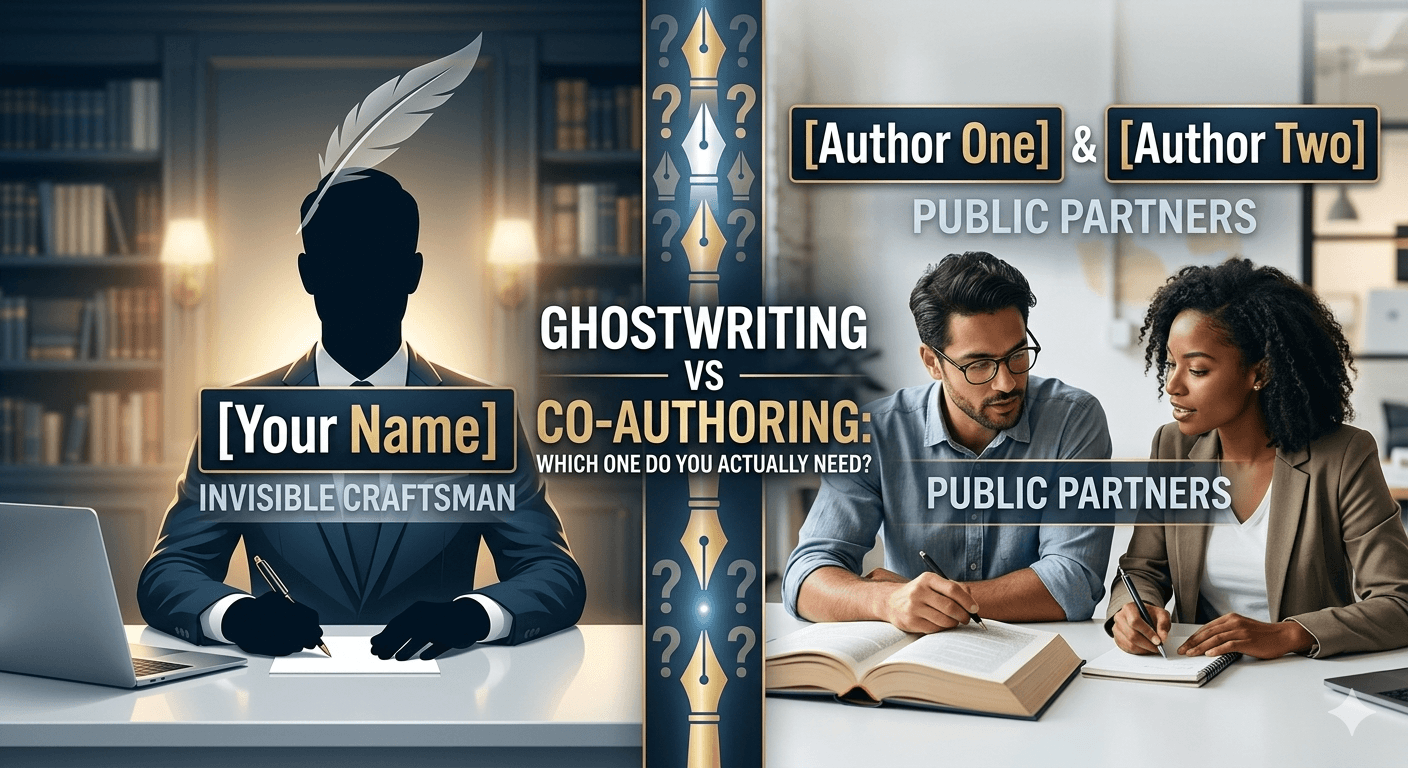
Ghostwriting means hiring a professional writer to create content published entirely under your name — you receive full credit, full ownership, and all royalties while the writer remains anonymous. Co-authoring means writing a book with a partner who shares public credit on the cover, contributes their own creative ideas, and typically receives a share of royalties in exchange for a lower upfront fee. Everything else in this article explains the implications of that difference — and helps you decide which arrangement is right for your project.
The One-Sentence Version
- A ghostwriter writes your book for you. You get all the credit, all the ownership, and all the royalties. The ghostwriter remains completely invisible.
- A co-author writes your book with you. Both names go on the cover. Ownership, creative control, and royalties are shared between both parties.
That is the core distinction. Everything else flows from it.
What Ghostwriting Actually Looks Like
When you hire a ghostwriter, you are entering a work-for-hire relationship. You are the client. You are the visionary. You bring the ideas, the expertise, the story, and the authority — and the ghostwriter brings the craft to turn all of that into a finished, polished manuscript.
Their name appears nowhere on the project. A comprehensive NDA prevents them from ever confirming they were involved. The ghostwriter’s job is to execute your vision to your satisfaction — not to contribute their own creative perspective or shape the book according to their own ideas. Every creative decision, every structural choice, every word ultimately serves your voice and your vision.
When the project is complete, you own everything. The copyright is entirely yours. The ghostwriter has been paid a flat fee and steps out of the picture permanently. You keep every penny of royalties, every speaking opportunity the book generates, every door it opens.
This is the right arrangement when you want to be recognized as the sole author, when privacy matters, when you are using the book to build a personal brand, or when the ideas and expertise are entirely yours and you simply need professional help expressing them.
What Co-Authoring Actually Looks Like
Co-authoring is a genuine creative partnership. Both parties contribute meaningfully to the development and writing of the book — and both are credited publicly on the cover for that contribution.
Because co-authors receive public credit and can use the work in their own portfolios, their upfront rates are typically lower than ghostwriting rates. Instead of a flat fee, co-authors usually share in any publisher advance and receive an agreed percentage of ongoing royalties — typically between 15% and 40% depending on the nature and extent of their contribution.
This sounds appealing on the surface — lower upfront cost. But it comes with real tradeoffs that most people underestimate. You share the cover. You share the creative direction. You share the royalties indefinitely. And you share certain decisions about the book’s future with someone who has their own professional interests, reputation, and goals that may not always align with yours.
Co-authoring works best when both parties are genuinely bringing something the other cannot provide alone — two subject matter experts combining knowledge, a researcher and a journalist making complex material accessible, or a practitioner and a writer whose specific expertise complements each other in ways that produce a genuinely better book than either could write alone.
Key Differences at a Glance
| Ghostwriting | Co-Authoring | |
|---|---|---|
| Credit | Your name only | Both names on cover |
| Ownership | You own 100% | Shared by agreement |
| Royalties | You keep all of them | Split (typically 60/40 to 85/15) |
| Upfront cost | Higher flat fee | Lower fee, ongoing profit share |
| Creative control | You have final say | Shared decision-making |
| Confidentiality | Ghostwriter bound by NDA | Co-author can discuss publicly |
| Personal brand | Book is entirely yours | Book represents both of you |
| Long-term returns | All yours | Divided indefinitely |
| Best for | Solo authority building | Genuine dual-expertise projects |
The Financial Reality People Often Miss
The upfront cost difference between ghostwriting and co-authoring is real — and it can make co-authoring look like the smarter financial choice when your budget is tight. But the long-term picture is often the complete reverse.
If your book generates speaking fees, consulting clients, media opportunities, and royalties over years — as most well-executed authority books do — a co-author who negotiated a 30% royalty share will continue receiving that share indefinitely. A ghostwriter who was paid a flat fee receives nothing from the book’s ongoing success.
For most professional books used as authority-building tools, the ghostwriting model is almost always the better long-term investment. The higher upfront cost is a one-time expense. Every return the book generates from that point forward belongs entirely to you.
There Is Also a Middle Ground
The publishing industry has developed some flexible arrangements that sit between pure ghostwriting and full co-authoring — and they are worth knowing about.
The “as told to” credit acknowledges the writer’s involvement without giving them equal billing: “by [Famous Person] as told to [Writer’s Name].” The named person remains the primary author; the writer is credited as a contributor.
The “with” credit works similarly: “by [Author] with [Writer’s Name].” These hybrid arrangements can be negotiated when a client wants to acknowledge the writer’s contribution without fully sharing authorship. They are most common in memoir and celebrity publishing, and less common in business books where sole authorship is usually important for professional credibility.
So Which One Do You Actually Need?
Choose ghostwriting if you want the book to be entirely yours in every sense — your name only, your ownership completely, your brand built solely around your expertise and story. You are comfortable making the upfront investment in exchange for keeping everything the book generates. Privacy matters. You are building personal authority. This describes the vast majority of professional ghostwriting clients.
Choose co-authoring if you are genuinely collaborating with someone whose contribution to the book is as substantial as yours, you are comfortable sharing the cover and the royalties, and you have a relationship with a potential co-author you trust enough to sustain a months-long creative collaboration — backed by a legal agreement that protects both of you if that relationship becomes complicated.
FAQs
What is the difference between a co-author and a ghostwriter?
A ghostwriter writes content published under your name, remains completely anonymous, and transfers all rights to you. A co-author is a credited writing partner whose name appears on the cover alongside yours and who shares royalties and creative control. The key distinction is credit and ownership — ghostwriters are invisible, co-authors are public partners.
Did Michelle Obama use a ghostwriter for her book Becoming?
Michelle Obama has not officially confirmed ghostwriting involvement, though Barack Obama has suggested she had writing assistance on the book. Becoming shows the hallmarks of professional narrative collaboration — structure, pacing, and prose quality consistent with an experienced writing partnership. The story, voice, and experiences are entirely hers, regardless of the level of writing support involved.
Can I use ChatGPT as a ghostwriter?
ChatGPT can generate text but it is not a professional ghostwriter. It has no access to your specific experiences, stories, or voice, and cannot conduct interviews or develop a genuine understanding of who you are. For low-stakes content it has some utility — but for a book, speech, or anything that carries your professional reputation, AI-generated content consistently falls short of what a skilled human ghostwriter produces.
Can you say co-authored on a book?
Yes — co-authored is a completely standard publishing term. When two or more people write a book together and share public credit, the book is described as co-authored and appears on the cover as “by [Author One] and [Author Two].” It carries no stigma and is widely used across every genre, from business books to memoirs.


