

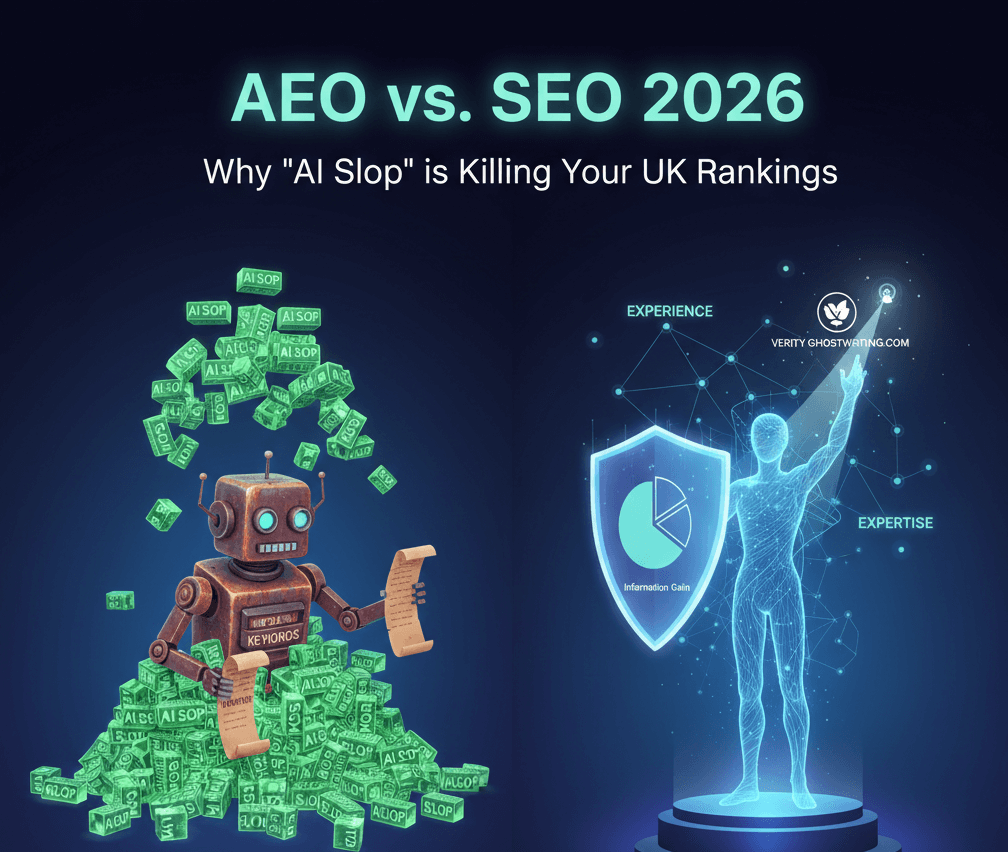
As of 2026, the primary difference between AEO (Answer Engine Optimization) and SEO is the shift from “ranking for keywords” to “earning citations.” AI search models like Google Gemini and ChatGPT now prioritize Information Gain—unique, human-led insights—over generic, AI-generated content (known as “AI Slop”). To stay visible, UK brands are returning to expert ghostwriters to provide the authority and original data that machines cannot replicate.
If you’ve spent any time looking at search results lately, you’ve likely felt that creeping sense of “deja vu.” Every second article feels like it was squeezed out of the same digital tube—hollow, repetitive, and strangely soulless. In the marketing world, we’ve started calling this “AI Slop.” For a while, it worked. Brands flooded the internet with cheap, generated content, and for a few months, the numbers went up.
But then the floor fell out.
As we move through 2026, the game has changed from SEO (Search Engine Optimization) to AEO (Answer Engine Optimization). Google’s AI Overviews and sophisticated Large Language Models have become the primary gatekeepers of information. They don’t just want keywords; they want Experience.
The Rise of AEO and the Death of the Generic
Traditional SEO was about convincing a bot that your page was relevant. AEO is about convincing an AI that your page is the definitive answer. When a user asks a complex question, the AI scans the web for a source that offers something new—a case study, a contrarian opinion, or deep industry expertise.
SEO vs. AEO: The 2026 Comparison
| Feature | Traditional SEO | Modern AEO (2026) |
| Primary Goal | Rank in the Top 10 blue links. | Get cited as the “Source” in AI Overviews. |
| Content Type | Keyword-optimized blog posts. | High-authority “Information Gain” assets. |
| Trust Factor | Backlinks and domain age. | E-E-A-T and verified expert authorship. |
| The “Slop” Factor | AI-generated text often ranks. | AI-generated text is filtered/ignored. |
| User Intent | Browsing and clicking multiple links. | Getting an immediate, verified answer. |
AI-generated content fails this test by design. Because LLMs are trained on existing data, they can only ever give you a “consensus” answer. They are incapable of having a new idea. If your website is just a remix of what everyone else is saying, the AI Overviews will ignore you. To rank in 2026, you need content that possesses “Experience” and “Expertise”—the first two letters of Google’s E-E-A-T framework that machines struggle to fake.
Why “Slop” is Killing Your Brand Reputation
Beyond the rankings, a massive trust deficit is growing among UK consumers. We’ve become incredibly fast at spotting AI-generated prose. The moment a potential client lands on your blog and reads a phrase like “in the ever-evolving landscape of…” or “it’s important to remember that…”, they check out.
In a world where content is infinite and free, authority is the only remaining scarcity.
Is your content “Slop” or “Source”?
Most UK brands are sitting on a goldmine of unwritten expertise. If your blog reads like a generic Wikipedia entry, you aren’t just losing SEO rankings—you’re losing your brand’s voice. Book a Content Authority Audit with Verity Ghostwriting to see where your information gaps are and how to turn your expertise into an AI-cited powerhouse.
The Ghostwriter’s Edge: Information Gain
The secret sauce for 2026 is a concept called Information Gain. If your article provides 10% more unique information than the current top result, you win. A professional ghostwriter knows how to find that 10%.
Professional writers achieve this through:
- Interview-led content: Turning raw conversations with experts into polished prose.
- Cultural Nuance: Writing specifically for the UK market with the correct tone, humor, and regional context that global AI models often miss.
- Narrative Flow: Building a logical argument that keeps a human reader engaged, rather than just hitting a checklist of keywords.
Frequently Asked Questions
What is the difference between AEO and SEO in 2026?
SEO focuses on ranking websites in traditional search results using keywords and backlinks. AEO (Answer Engine Optimization) focuses on providing the direct, authoritative source that AI models like Gemini and ChatGPT cite in their summaries. AEO prioritizes “information gain”—new, unique insights that distinguish your content from generic data.
Why is AI content (AI Slop) losing its ranking?
Search engines and AI models now prioritize E-E-A-T (Experience, Expertise, Authoritativeness, and Trustworthiness). Since AI content is built on existing data, it lacks original “Experience.” Google identifies this repetitive, unoriginal text as “slop” and filters it out of AI Overviews in favor of expert-led, human-written perspectives.
How can ghostwriting improve my website’s AI visibility?
Expert ghostwriters conduct interviews and research to uncover proprietary insights that AI cannot find. By publishing this “hidden” expertise, your site becomes a primary source for AI engines. This original value earns you citations in AI Overviews, driving high-intent traffic from users looking for authoritative, human solutions.
Will professional writing still get clicks in an AI world?
Yes. While AI provides quick summaries, users click through to sources they trust for a deeper understanding. High-quality ghostwriting builds that trust by offering a “Human-in-the-loop” experience. In 2026, the value of a professional writer is in creating the emotional resonance and authority that turns a searcher into a lead.
The brands winning the “AEO war” are those that treat their blog not as a dumping ground for SEO keywords, but as a library of genuine authority. They understand that while AI can write a sentence, it can’t tell a story. And in 2026, the story is what gets you the click.


